
If It’s Advertised to You Online, You Probably Shouldn’t Buy It. Here’s Why.. Ads are serving us lousy, overpriced goods. (NYTimes / Julia Angwin).
Not covered in this article: Microtargeted ads are reportedly no more effective than contextual ads. So we’re giving up our privacy, advertisers are paying a premium, and the advertisers aren’t even making more money than they’d make if they just advertised their refrigerators against people searching Google for the word “refrigerator.”
For more than two decades, Thomas has accepted luxury trips virtually every year from [Dallas businessman Harlan Crow] without disclosing them, documents and interviews show. A public servant who has a salary of $285,000, he has vacationed on Crow’s superyacht around the globe. He flies on Crow’s Bombardier Global 5000 jet. He has gone with Crow to the Bohemian Grove, the exclusive California all-male retreat, and to Crow’s sprawling ranch in East Texas. And Thomas typically spends about a week every summer at Crow’s private resort in the Adirondacks.
The extent and frequency of Crow’s apparent gifts to Thomas have no known precedent in the modern history of the U.S. Supreme Court.
The luxury trips contrast starkly with the public reputation Thomas has cultivated.
In Thomas’ public appearances over the years, he has presented himself as an everyman with modest tastes.
“I don’t have any problem with going to Europe, but I prefer the United States, and I prefer seeing the regular parts of the United States,” Thomas said in a recent interview for a documentary about his life, which Crow helped finance.
“I prefer the RV parks. I prefer the Walmart parking lots to the beaches and things like that. There’s something normal to me about it,” Thomas said. “I come from regular stock, and I prefer that — I prefer being around that.”
— Joshua Kaplan, Justin Elliott and Alex Mierjeski at ProPublica
Cory Doctorow reviews Thomas’s ignominous career. “… the elevation of the unrepentant rapist Brett Kavanaugh to the bench could never have occurred but for the trail blazed by Thomas as a sexually harassing, pubic-hair distributing creep boss.”
Thomas wants to ban same-sex marriage again, Cory notes. “And of course, he’s set precedent by hearing cases related to the attempted overthrow of the US government, despite the role his wife played in the affair.”
Thomas is not alone in furthering the right’s mission to destroy the morale of constitutional law scholars by systematically delegitimizing the court and showing it to be a vehicle for partisan politics and dark money policy laundering, but he is certainly at the vanguard.
Today I learned “Fiddler on the Roof” is a smash hit in Japan.
Since 1967, the musical’s seen hundreds of Japanese revivals. Joseph Stein, who penned the book to Fiddler, was once approached by a Japanese producer who asked, “Do they understand this show in America?”
“Yes, of course,” replied Stein, “we wrote it for America. Why do you ask?”
“Because,” the producer said, “it’s so Japanese.”
— 12 Things You Might Not Know About ‘Fiddler on the Roof’ (Mental Floss / Mark Mancini)
We watched “Murder Mystery,” a 2019 comedy-mystery starring Adam Sandler and Jennifer Aniston as married couple Nick and Audrey Spitz, a New York cop, and a hairdresser. On a flight to Europe for a bus-tour vacation, she strikes up a friendship with a dapper gentleman on the plane. The dapper gentleman spontaneously invites the New Yorkers to join him for a celebration on his billionaire uncle’s yacht. On the yacht, someone is murdered, and the Spitzes are the prime suspects.
It is an oddly old-fashioned movie. The gags all depend on the premise that the Spitzes are amiable lower-class shmos in a world of elegant toffs. We’re at an Agatha Christie murder mystery on a yacht, but instead of Hercule Poirot, our heroes are Oscar Madison and Laverne from Laverne & Shirley. Even the names Nick and Audrey Spitz seem to echo Nick and Nora Charles. I particularly liked the wardrobes—Sandler in baggy cargo shorts surrounded by men and women in tailored evening wear, Aniston in her outfits from Target (not Marshalls—she’s very clear on that point!).
The movie clocks in at 97 minutes, the ideal length for a movie, and ends in a lovely car chase through European streets.
You will like this movie very much if this sounds like the kind of movie you’d like. It is, and we did. 🎥

Well played, Switchzilla! Cisco trashed its offices and equipment as it rolled back operations in Russia, and then claimed the property damage as depreciation in its tax filings to Moscow. (The Register / Simon Sharwood)
We’ve been watching “Shadow and Bone.” I’m not into it but Julie is, so I guess I’ll give it another episode or two. jwz is really not into it, and he gave it both seasons.
… the villain in this show looked like he wandered in from a different sound stage. He looked like the kind of guy who would be trying to shut down the rec center to build a condo, not an evil wizard. Everyone else had their Tolkien costume on, and this guy just looked like some douche you’d have met at a goth club in the 90s who called himself “Vlad” and carried a wolf-head cane. Maybe there was a casting mix-up and some lawyer show ended up with a prosecutor with a giant Gandalf beard.
I’ve been thinking lately that I read too much national political news and post too much about national politics.
I may have more to say on this subject, but until then here is an excellent related article by Ryan Broderick at Garbage Day:
Yesterday, in a lull between the release of the Barbie movie trailer and the second Spider-Man: Into The Spider-Verse trailer, former President Donald Trump was arrested and arraigned. I do not have cable because it’s 2023 and I am under the age of 55, but according to the clips that made it to Twitter, it seemed like a fun time for America’s news anchors. For instance, CNN gave us some valuable insight into how many doors and hallways the Manhattan courthouse has.
Also, None of This Garbage Is Important. Hamilton Nolan at In These Times:
NEW YORK CITY — At the criminal court in downtown Manhattan today, nothing important happened. Believe me. I was there. There were no meaningful occurrences of true consequence. Certainly nothing worthy of a claim on your limited attention. I wouldn’t bring it up at all, except that I fear that my friends and I in the media may be about to gleefully poison this nation, one more time.
One thing about New York City is that it is home to a large population of reporters, of which I am one, that will reliably turn up at any spectacle. Not out of any nefarious motives. We do this for the same reason that residents of small towns turn up at the county fair: It’s something to do.
For decades, scientific studies suggested moderate drinking was better for most people’s health than not drinking at all, and could even help them live longer.
A new analysis of more than 40 years of research has concluded that many of those studies were flawed and that the opposite is true.
— New York Times / Roni Caryn Rabin
That kind of bad news will drive a person to drink
I’m supposed to go for a blood test tomorrow morning for life insurance, but the address they gave me on the phone is one number off from the address on Apple Maps, and Apple Maps shows the clinic as permanently closed, and the operator on the phone said the name on the sign is different from the name of the clinic. So now I’m wondering whether I’m going to get my blood taken by a couple of meth-heads in back of a 7-Eleven parking lot.
A bit of family history, from my father’s service in Word War II
My father received these humorous fake orders when he was discharged from the army in 1945, the end of the war.
I found this document while doing some decluttering in my home office yesterday. The paper is brown with age and fragile to the touch. It’s apparently typed and mimeographed.
The document is written in the style of a military memo, instructing the men how to behave when they get back home to civilian life.
In America there are a remarkable number of beautiful girls. These young ladies have not been liberated and many are gainfully employed as stenographers, sales girls, beauty specialists, and welders. Contrary to current practices, they should not be approached with, “How much?” A proper greeting is, “Isn’t it a lovely day!” or “Have you ever been to Chicago?” Then ask, “How much?”
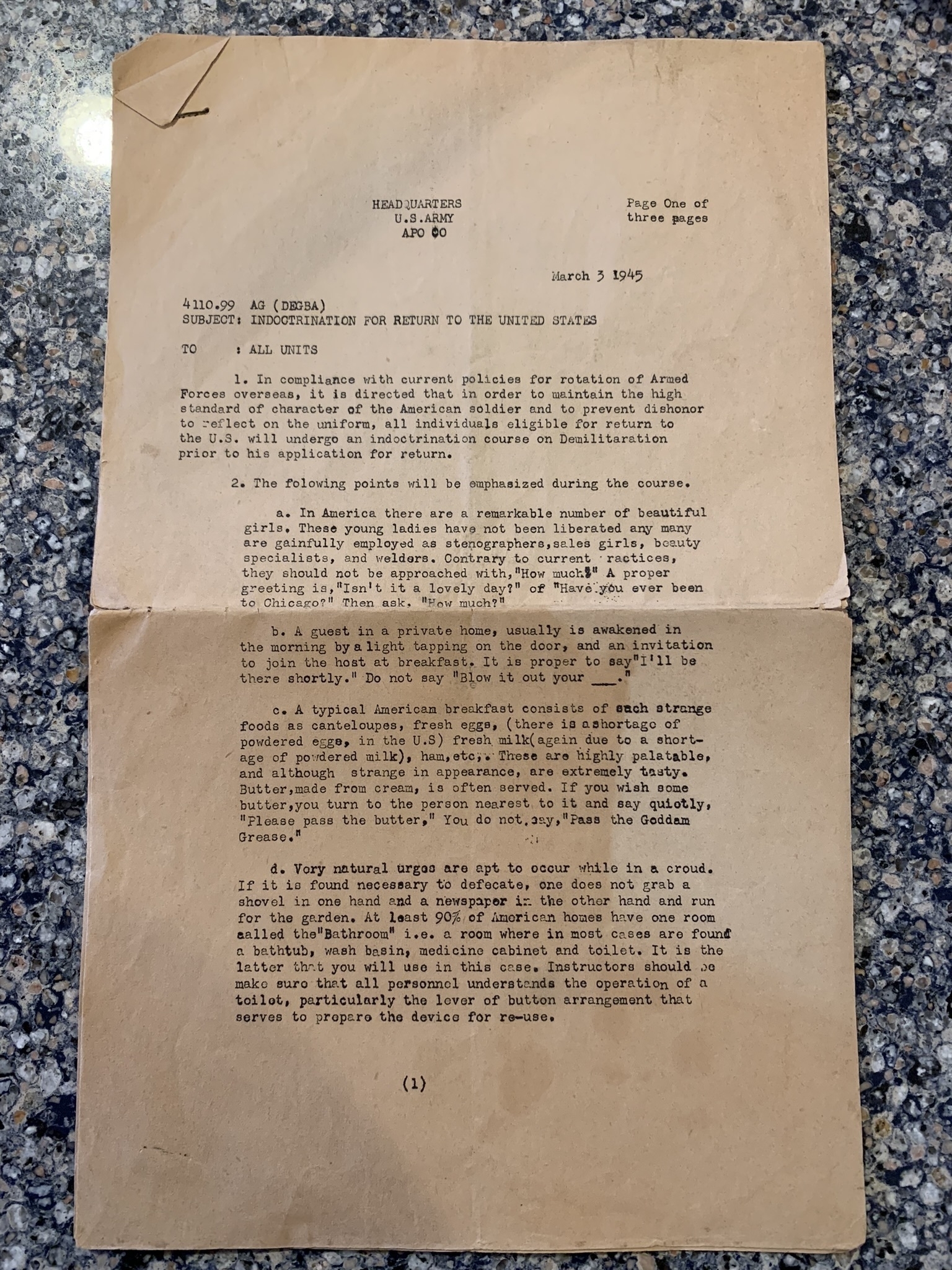
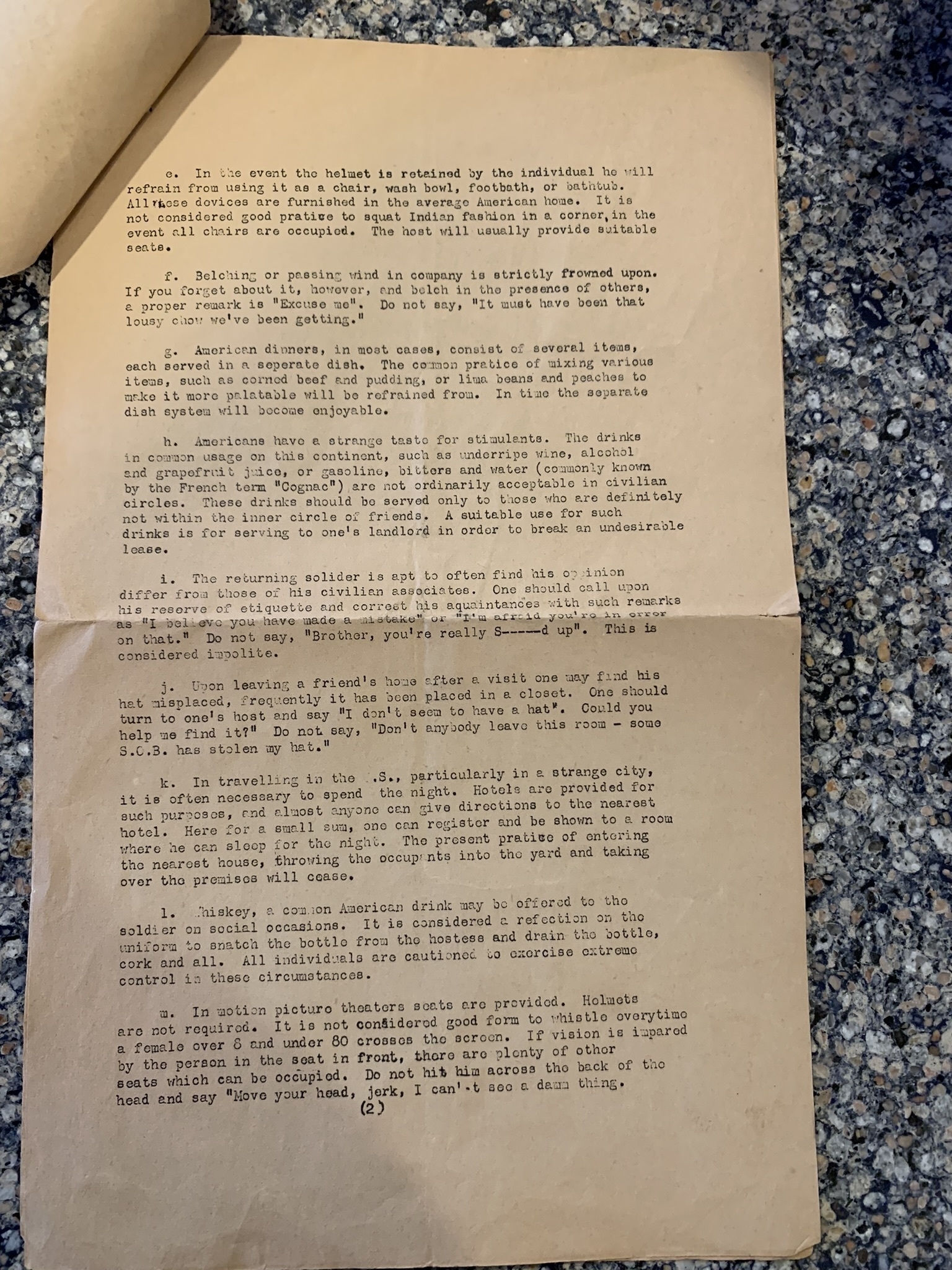
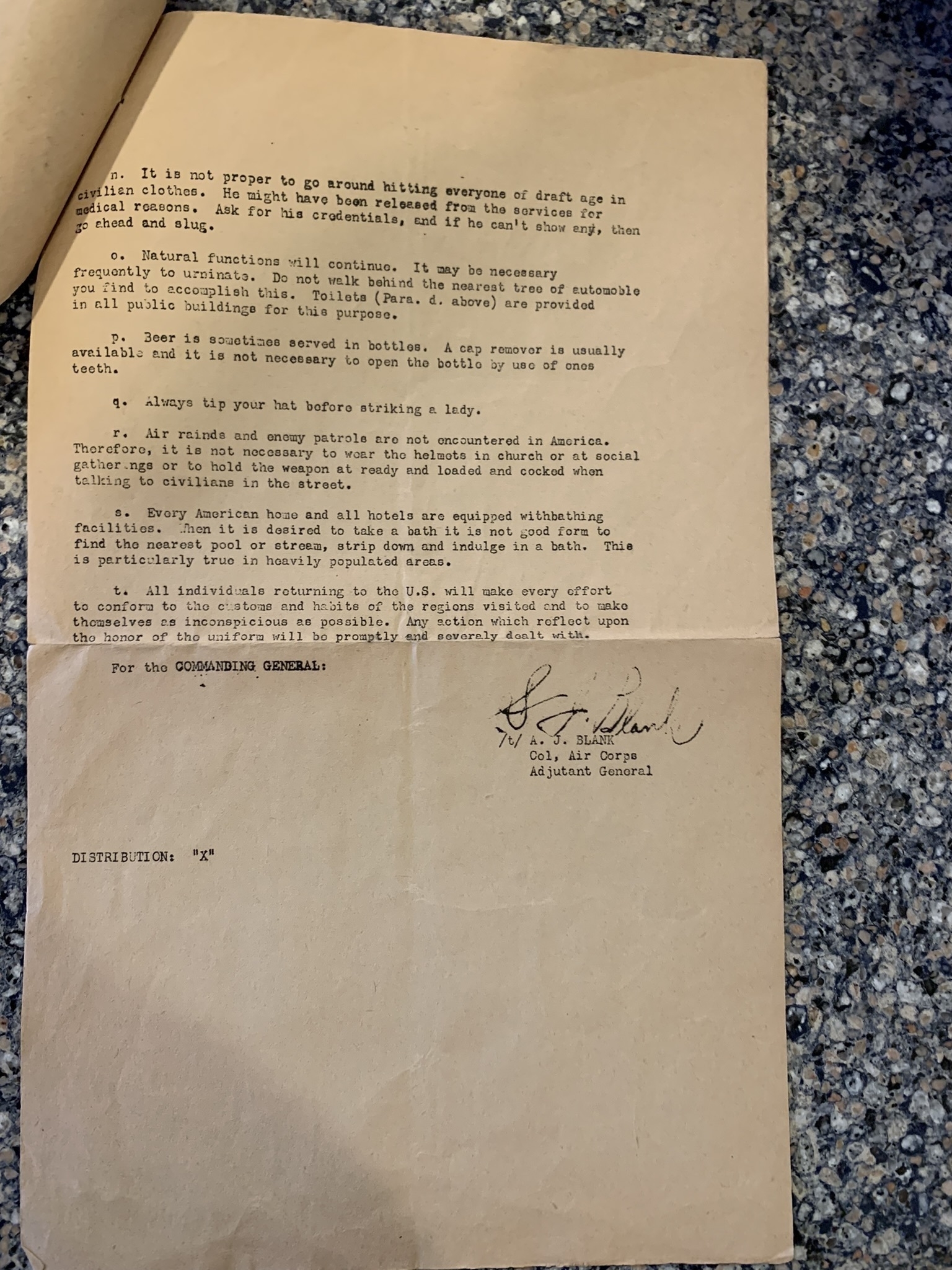
My father served in Burma, which is now Myanmar. I think he also did some time in Taiwan. When he was discharged, he was 21 years old. I think he served several years. A kid from Brooklyn. My father’s native habitat was the New York suburbs; I cannot imagine him in tropical Asia.
I found this document when I was a teenager in the 1970s, investigating the garage of our house on Long Island. I found it again while going through my Dad‘s papers after he passed in 2004. After that, the document disappeared into the clutter of my home office for nearly 20 years until I was decluttering this week, and the papers turned up again.
I’m giving Readwise Reader another try as a read-it-later service after using Matter for several months. Matter is great, but I’m hoping for better search capabilities. I’m starting to do tech news again, on a freelance basis, for Silverlinings, and I want to start building a clippings library.
I have friends who used to go see movies at random. They caught movies the first days the movies were released before they saw trailers or ads or reviews. They would go to a theater, buy a ticket, and see whatever was playing. One of these friends based decisions on movie posters, and solely the posters. Another would drive to the multiplex and see the next movie that was playing after he got out of the car.
Having just seen “John Wick” and “Everything Everywhere All At Once,” I get the appeal of that system. The first half hour of both of those movies are very different from what comes later, and it would have been a delightful surprise to see all that spool out without expectations.
The first half hour of “Everything Everywhere” looks like an arty family drama about a middle-aged woman who’s estranged from her daughter and husband and struggling to save the family business. No science fiction or fantastic elements at all.
In the first half hour or so of “John Wick,” you don’t know he’s a super-hitman. You first get an idea when John Leguizamo recognizes the car. We’ve already seen those Russian young men are extremely dangerous, but John Leguizamo is more afraid of John Wick than of the Russians. We don’t discover John Wick’s full story until Viggo confronts his son.
Back to “Everything Everywhere:” A great thing about that movie is that it really is primarily an arty family drama about a middle-aged woman who’s estranged from her daughter and husband and who is struggling to save the family business. The science fiction serves that story. Saving the multiple universes is the B-plot. 🎥
Today I learned that Fletcher Previn, CIO of $52 billion networking company Cisco Systems, is the son of actress Mia Farrow and composer-conductor Andre Previn. (Computerworld / Lucas Mearian)
Also, while many companies are mandating a return to the office, Cisco CEO Chuck Robbins said in April 2021 that the company is committed to remote work indefinitely, and they’re standing by that. “Our policy around hybrid work is that we want the office to be a magnet and not a mandate,” says Previn.
The Day Windows Died. By Thomas Bandt.
Jackson Heights: The neighbourhood that epitomises New Yorkl. “Travellers may go to Central Park or Times Square to see New York City, but there’s no better place to feel the city’s DNA and understand how it started than here.” (BBC Travel / Sebastian Modak). I love New York. I grew up on Long Island, about 50 miles from Jackson Heights. haven’t been back in far too long.
Why don’t we have Cher Horowitz’s automated closet from the 1995 movie “Clueless?”. On the Articles of Interest podcast by Avery Trufelman.