
Greatest Hits
We watched “Murder Mystery,” a 2019 comedy-mystery starring Adam Sandler and Jennifer Aniston as married couple Nick and Audrey Spitz, a New York cop, and a hairdresser. On a flight to Europe for a bus-tour vacation, she strikes up a friendship with a dapper gentleman on the plane. The dapper gentleman spontaneously invites the New Yorkers to join him for a celebration on his billionaire uncle’s yacht. On the yacht, someone is murdered, and the Spitzes are the prime suspects.
It is an oddly old-fashioned movie. The gags all depend on the premise that the Spitzes are amiable lower-class shmos in a world of elegant toffs. We’re at an Agatha Christie murder mystery on a yacht, but instead of Hercule Poirot, our heroes are Oscar Madison and Laverne from Laverne & Shirley. Even the names Nick and Audrey Spitz seem to echo Nick and Nora Charles. I particularly liked the wardrobes—Sandler in baggy cargo shorts surrounded by men and women in tailored evening wear, Aniston in her outfits from Target (not Marshalls—she’s very clear on that point!).
The movie clocks in at 97 minutes, the ideal length for a movie, and ends in a lovely car chase through European streets.
You will like this movie very much if this sounds like the kind of movie you’d like. It is, and we did. 🎥
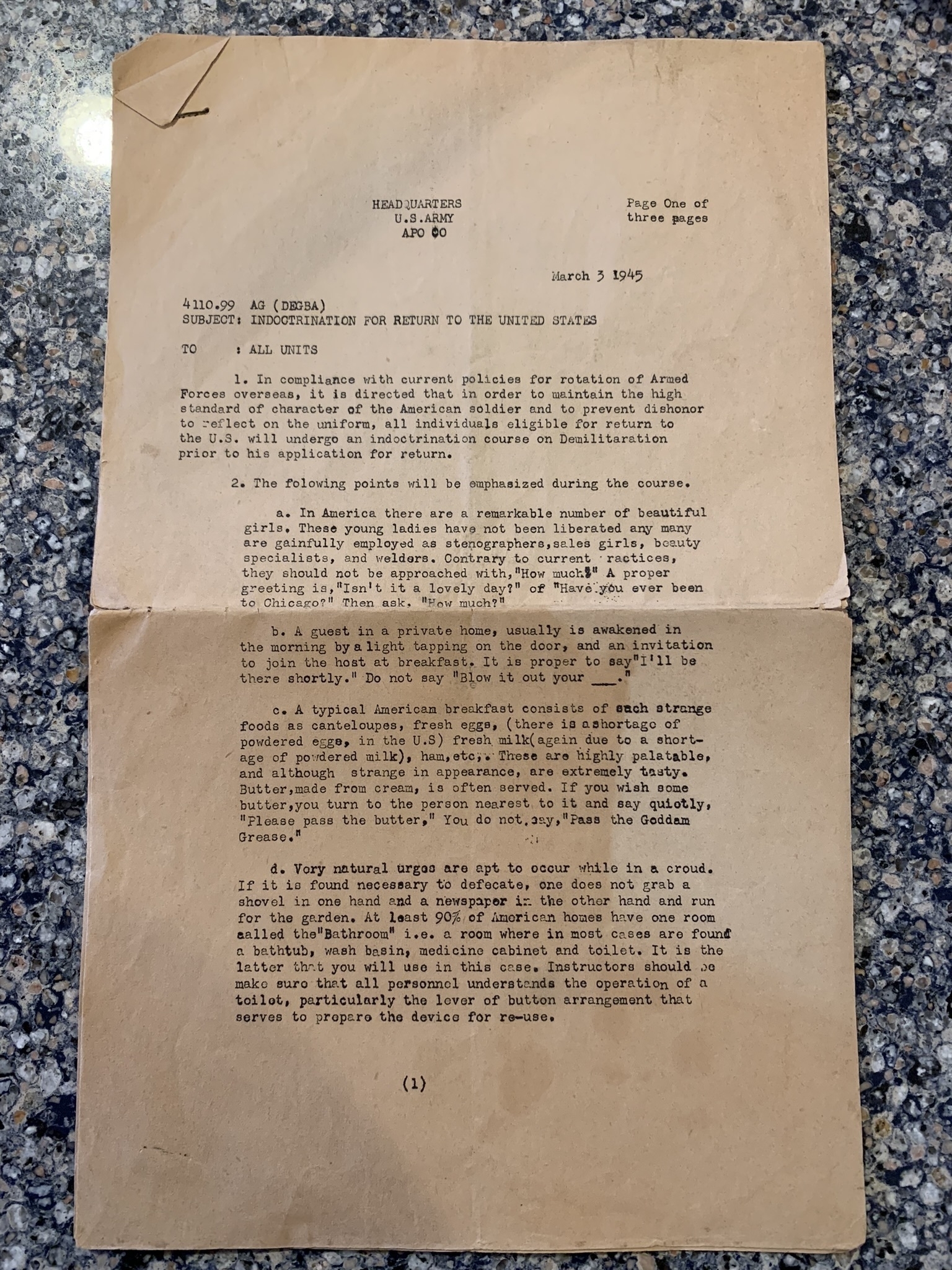
A bit of family history, from my father’s service in Word War II
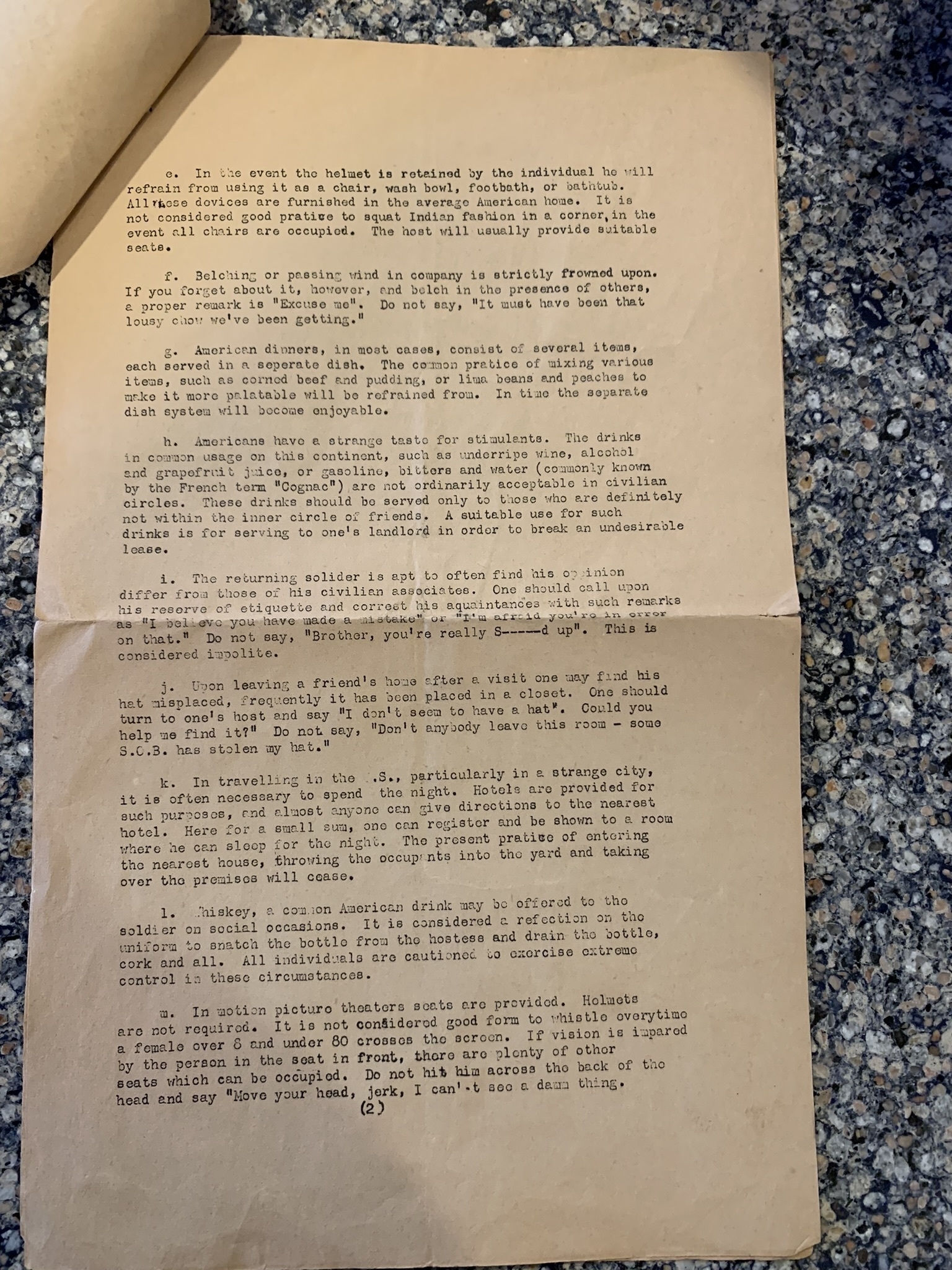
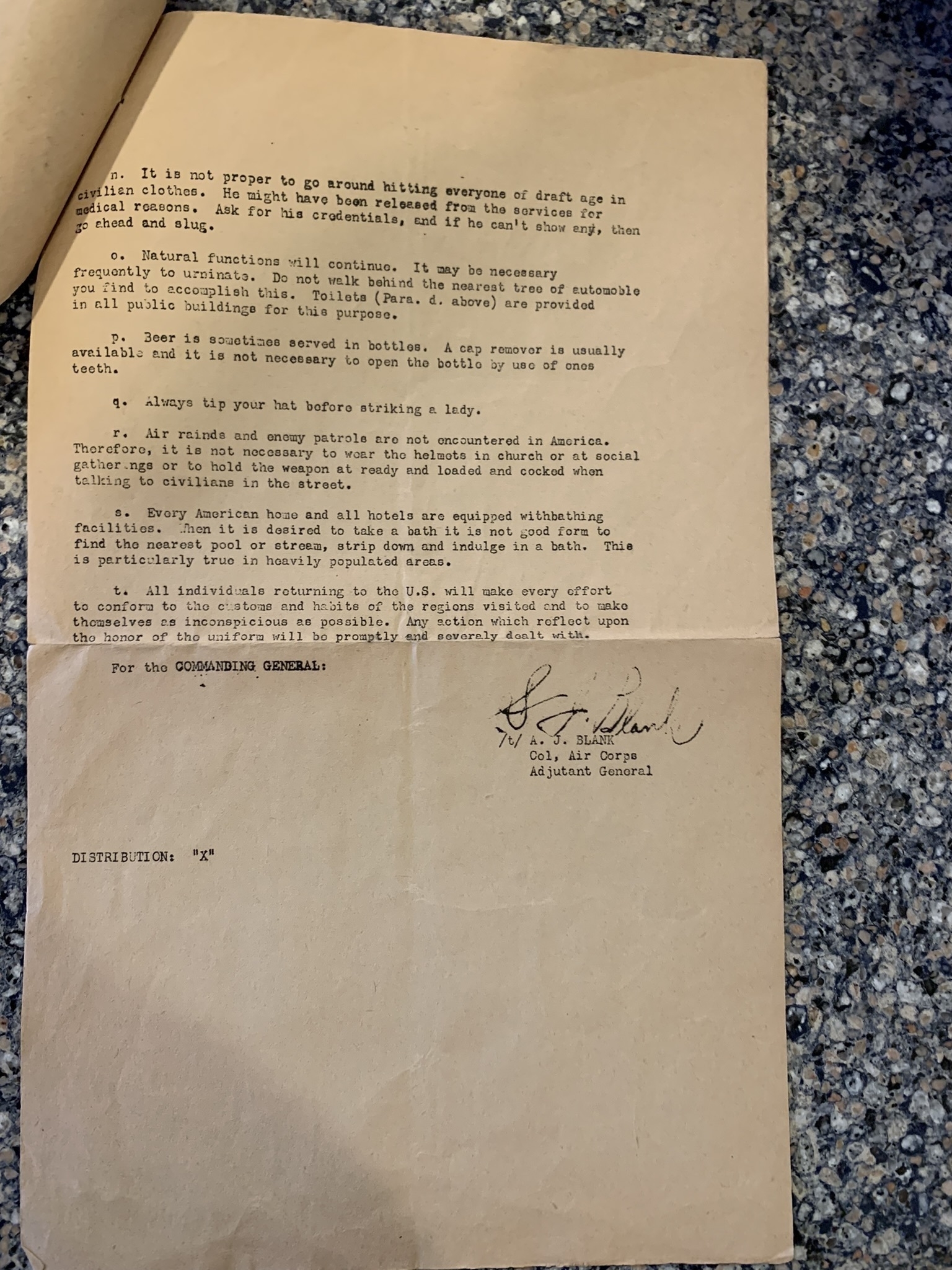
My father received these humorous fake orders when he was discharged from the army in 1945, the end of the war.
I found this document while doing some decluttering in my home office yesterday. The paper is brown with age and fragile to the touch. It’s apparently typed and mimeographed.
The document is written in the style of a military memo, instructing the men how to behave when they get back home to civilian life.
In America there are a remarkable number of beautiful girls. These young ladies have not been liberated and many are gainfully employed as stenographers, sales girls, beauty specialists, and welders. Contrary to current practices, they should not be approached with, “How much?” A proper greeting is, “Isn’t it a lovely day!” or “Have you ever been to Chicago?” Then ask, “How much?”
My father served in Burma, which is now Myanmar. I think he also did some time in Taiwan. When he was discharged, he was 21 years old. I think he served several years. A kid from Brooklyn. My father’s native habitat was the New York suburbs; I cannot imagine him in tropical Asia.
I found this document when I was a teenager in the 1970s, investigating the garage of our house on Long Island. I found it again while going through my Dad‘s papers after he passed in 2004. After that, the document disappeared into the clutter of my home office for nearly 20 years until I was decluttering this week, and the papers turned up again.
I have friends who used to go see movies at random. They caught movies the first days the movies were released before they saw trailers or ads or reviews. They would go to a theater, buy a ticket, and see whatever was playing. One of these friends based decisions on movie posters, and solely the posters. Another would drive to the multiplex and see the next movie that was playing after he got out of the car.
Having just seen “John Wick” and “Everything Everywhere All At Once,” I get the appeal of that system. The first half hour of both of those movies are very different from what comes later, and it would have been a delightful surprise to see all that spool out without expectations.
The first half hour of “Everything Everywhere” looks like an arty family drama about a middle-aged woman who’s estranged from her daughter and husband and struggling to save the family business. No science fiction or fantastic elements at all.
In the first half hour or so of “John Wick,” you don’t know he’s a super-hitman. You first get an idea when John Leguizamo recognizes the car. We’ve already seen those Russian young men are extremely dangerous, but John Leguizamo is more afraid of John Wick than of the Russians. We don’t discover John Wick’s full story until Viggo confronts his son.
Back to “Everything Everywhere:” A great thing about that movie is that it really is primarily an arty family drama about a middle-aged woman who’s estranged from her daughter and husband and who is struggling to save the family business. The science fiction serves that story. Saving the multiple universes is the B-plot. 🎥
I tried Grammarly yesterday and I like it a lot
I published two posts here yesterday and noticed copyediting errors after publication. This troubled me partly because I had a whitepaper due later that day, and I was concerned about sloppy mistakes in paying copy.
So I decided, “I’ve heard good things about Grammarly. I’ll give that a try.”
Holy cow! It’s fantastic!
Also, humbling.
Grammarly flagged 95 suggestions in a 2,200-word whitepaper. It suggested replacing the first three words of the whitepaper with a single word. Most of the changes it recommended were along those lines; tightening up the text by eliminating unnecessary words.
However, some of Grammarly’s recommended changes would have introduced errors in my work, and I had to dismiss those. Grammarly doesn’t run on autopilot.
Overall, I’m delighted with Grammarly, and I’m signing up for a one-year subscription now.
And yes, Grammarly reviewed this post. It recommended seven changes. I accepted most of them.
Logseq vs. Obsidian: First impressions
I played with Logseq a bit as an alternative to Obsidian, or complement for it.
Logseq seems like a simplified version of Obsidian that does less. For many people that will be a plus. Fewer options equals fewer things to fiddle with and potentially break.
Logseq is an extreme outliner. It wants everything you do to be an outline. Obsidian supports outlining, but Logseq is more opinionated and more powerful as an outliner. That’s a minus for me; I do use outlines but mainly I just write prose.
Logseq wants you to limit yourself to store everything in just four folders, and organize all your data using links instead. My brain doesn’t work that way. I make heavy use of folders.
Logseq is open source, which makes it—possibly—more futureproof and secure than Obsidian.
I don’t think I’m going to stay with Logseq. It doesn’t seem to be different enough from Obsidian to be worth the hassle of switching.
Still, Logseq seems to be a great app for people who are looking for an extremely powerful outliner. And I may come back to it.
And playing with Logseq gave me some ideas for doing a better job of organizing and using my Obsidian vault. I need to use the Daily Note more, and move blocks of text between notes using the Text Transporter plugin
I just pledged $53 to the Kickstarter for Cory Doctorow’s upcoming novel, “Red Team Blues.” In pledging, I’m supporting the excellent work Cory (who is on Mastodon as @pluralistic@mamot.fr) does on his blog and podcast, which are free.
The $53 pledge gets me a nice hardcover, which I might donate to the local library, because I’m an ebook guy. Backers at that level also get an audiobook, and an ebook too. The audiobook and ebook are DRM-free, which will surprise nobody who follows Cory.
A pledge of $1,000 or more lets you name a character in the sequel, and $3,000 or more gets you—check this out!—a deluxe hardcover with a secret compartment.
More info from Cory: Kickstarting the Red Team Blues audiobook, which Amazon won’t sell
I’ve read an advance copy of the novel. It’s terrific. Very suspenseful!
What is a “digital garden?”
I encountered the idea of a “digital garden” Friday and was instantly enthusiastic and spent some time this weekend nerding out about it. Here is the result – the beginning of my digital garden: mitchwagner.com.
A digital garden is a personal website curated by its author, with essays and information about the subject or subjects they’re excited about. Some are wide-ranging and complex and cover a variety of subjects, while others cover a single subject, such as neurology or books,
Here’s a directory of digital gardens. It’s a digital garden of digital gardens!
Digital gardens provide an alternative to chronological streams such as blogs and social media. Streams are great for finding out what’s happening and whats new now. But they’re lousy for organizing information. Also, streams are terrible for longevity. Once stuff gets pushed down off the top of the stream, it disappears. Digital gardens are places where you can organize information and keeping information available over the long term.
Digital gardens can be very simple, just an index page or a Google Doc. Or you can use sophisticated software to create complex, Wikipedia-like documents.
After a while thinking about this idea, I realized that we’re talking here about the old, 90s “personal website.” People back then would create websites devoted to their favorite bands, or hobbies, or just their own lives and interests. Eventually these got swallowed up by Wikipedia, Google and the various social media silos.
Digital gardens are an extension of, and renaming of, personal websites. That doesn’t make the idea less powerful though.
Digital gardens are exciting to me, personally, because they solve a couple of problems that I’ve been noodling about for years. One problem is that I post a lot of stuff to my streams. Some days I post a dozen or two dozen items. Most are ephemeral – links to breaking news articles, some with comments, some without. Wisecracks. Memes. Old ads and photos from the mid-20th Century.
But some of what I post seems like it should be more long-lasting, whether it’s a book review or the journal of our 25th anniversary safari to Africa last year.
A digital garden solves that problem. I can just put up an index page of links to long-lived and notable content, and let that — rather than the blog or my biography — be my home page. I’ll continue with the blog and keep the bio. But the index page will be the main entrance to my site.
Again, this is not a new idea. Gina Trapani has been doing that a few years, and I don’t think she would say her idea is particularly original to her. But it’s still a great idea — and it’s new to me.
The second problem that digital gardens solve for me is that I’ve been noodling about ideas for projects for, well, several years now. Interviews with people I find interesting, software reviews and how-tos. Occasionally I have even acted on these ideas. But I don’t do it often because I don’t have a permanent home for them.
Resources
My digital garden: mitchwagner.com.
Here’s the article that got me excited, and introduced the idea of “digital gardening” to me: Digital gardens let you cultivate your own little bit of the internet
How the blog broke the web – Amy Hoy provides a brief history of blogs and social media, and discusses why they’re not great ways to organize information.
Hoy says there were only 23 blogs in 1999? Amazing. By late 2001 there seemed like a million of them.
Maggie Appleton: A Brief History & Ethos of the Digital Garden – Apparently the term and idea has been around in various forms for more than 20 years. Not surprising. The internet is a tangled web. Streams and search engines are two great ways to find stuff, but stuff can still be hard to find. That’s not a new problem.
Maggie Appleton’s directory of digital gardeners and digital gardening tools
Maggie’s Digital Garden
Maggie again: A brief overview of digital gardens as a Twitter thread.
A list of artificial brain networked notebook apps – These include a couple of familiar names to me, such as Roam Research and Obsidian. They seem to be a mix of private note-taking apps, Internet publishing tools, and private apps that can also publish to the public web.
This is a take on “digital gardens” that borrows from the philosophy of “zettelkasten.” Put simply, a zettelkasten is a system of note-taking where you write down each idea separately — in its original vision decades ago, you wrote each idea on a slip of paper or index card, though now of course there are digital versions — and then link madly between related notes. Ideas can come from books, articles, thinking, observations, whatever. Zettelkasten advocates say they can come up with fresh insights simply by returning to their zettel and following the links. German sociologist Niklas Luhmann, who invented the idea, credited his zettelkasten as a collaborator on many papers and books.
You don’t have to use dedicated software for a digital garden. Mine is just an index page for my existing blog.
Second Brain – “A curated list of awesome “Public Zettelkastens 🗄️ / Second Brains 🧠 / Digital Gardens 🌱”
Digital Gardens – Another explainer with a couple of examples. The author says:
In basic terms, [a digital garden] is a different format for written content on the web. It’s about moving away from blog posts ordered by dates and categories, into more of an interlinked web of notes.
One of the main ingredients is bi-directional links between those notes, creating a network of notes, similar to Wikipedia.
I would not say that the notes have to be interlinked, Wikipedia-style. Though they can be.
gwern.net – A very nice example of a digital garden covering a broad range of subjects.
Article: My blog is a digital garden, not a blog by Joel Hooks.
I don’t use ad-blockers because I hate ads
I’m a journalist. I’m fine with ads. They pay my income.
I don’t use ad-blockers to protect my privacy. When it comes to the Internet, I’m just a typical shmo — I complain about privacy invasion but I do very little to protect my privacy.
I use ad-blockers because ad-tech makes the web unusable. Ads and pop-ups obscure the articles I’m trying to read. Which is nuts; it’s like websites are inviting hackers to come in and break their own sites. Ads slow down my Mac until the machine becomes unusable. I have a midrange 2018 MacBook Pro. It is not an underpowered machine, and yet ad-tech routinely slows it to a crawl.
We used to complain about TV commercials, but Internet advertising is way worse. TV commercials limited themselves to their own little time blocks. TV commercials didn’t shout over the dialogue on a TV show, or jump in between the camera and the actors so you couldn’t see the action.
Likewise, in magazines and newspapers, the ads didn’t creep from one side of the page to cover up the article. Nobody in 1973 was ever sitting at the kitchen table reading a magazine article only to have an ad cover up the article nagging them to subscribe to the newsletter.
The ad-tech is winning here. I use 1Blocker. It’s just not good enough, and I’m not motivated to shop around and look for alternatives, in part because it does not seem obvious to me that there is anything better than 1Blocker available.
I don’t know what the end-state here is. Maybe the best sites will start to mix subscriptions and advertising, which is a business model refined for print periodicals over the course of a century or more. And the ads will get more restrained, because the subscribers are paying customers.
By the way, here’s a secret of newspapers and magazines in the late 20th Century: The subscriptions didn’t turn a profit. They broke even, paid for the cost of production. The primary purpose of the subscription was to demonstrate to advertisers that there were people willing to pay for the periodical, and therefore these people were worth the cost of advertising too.
The problem with subscription models on the Internet is that there are too many newspapers, magazines and blogs to subscribe to, particularly if you might only want to read one article. This seems solvable, but it’s a big deal for now. 🌕
Help Garry Armacost, a Vietnam vet, fight cancer and VA bureaucracy
Garry Armacost, was wounded fighting for his country in Vietnam. Now he’s in the fight of his life, against cancer and the bureaucracy of the Department of Veterans Affairs.
Garry is a big, cheerful, quiet 75-year-old who lives in San Diego. He needs cancer surgery for his survival. The surgery is complicated, long, done robotically, and requires sophisticated post-operative care.
Garry has had bad experience with post-operative care at the VA, which proved nearly fatal in 2012. Fortunately, Garry’s son, Chris, is a doctor, and arranged for the head of urology at Sharp Memorial to do the surgery.
But the VA has refused the transfer because they don’t want to cover the cost.
“What price do they put on Garry’s life? Apparently not much,” Garry’s wife, Linda, writes in a Facebook post. “We have called, argued, pleaded, tried to talk with the Director, to no avail. We’re wondering if these will be our last days together. It didn’t need to come to this.”
Garry was wounded in Vietnam, and earned a purple heart. He came home, raised a family, and worked a long career for various railroads in the Northeast. He is now retired and lives with his wife, Linda, in San Diego. Linda is active in local Democratic Party politics, which is where I met her.
Please help Garry and his family. If you have any ideas on who to contact and otherwise how to influence the VA to give him the treatment he needs, let me know and I’ll pass the word. You can contact me directly at mitch@mitchwagner.com.
If you work for the VA or know someone who does, please put in a word to get Garry’s transfer approved. Contact your Congressional representative and apply pressure.
Share this post far and wide on social media.
The VA needs to be held accountable to provide care, not just for Garry, but for every veteran. They were there when we needed them – now we need to be there for them, when they need us.
“It may not work for me," says Garry, “but hopefully another vet will have a better outcome.”


🌕📓