Posts in "Greatest Hits"

Something I noticed re-reading Roger Zelazny's "Doorways in the Sand"

I recently re-read Roger Zelazny’s “Doorways in the Sand,” which I last read when I was a teen-ager. I loved it as much today as I did then. One of my favorite Zelazny books, which makes it one of my favorite books.

In that novel, a character in his 60s is looking back on his life and says that the world goes through one massive change after another—but they happen one at a time, spaced out at long intervals, and after each change life goes back to pretty much what it was before, so you can convince yourself nothing has changed.

Then you look back over the course of 40+ years and the world is completely different from when you were 20 years old.

I glided over that passage when reading it first as a teen, but re-reading it again over the past few months it hit me hard.

In my adult lifetime, we’ve seen the emergence of he Internet, smartphones, the rise of China, the end of the Cold War, Covid, Donald Trump, the fall of the USSR—after each of these events, we could say, “That was a big deal but still our day-to-day lives are not much different than they were before” And yet you put it all together and the world is very, very different than it was in 1981.

This rule does not apply if you or someone close to you is personally affected by any of these global changes. And these changes can affect hundreds of millions of people — that’s what makes them global. But billions of people are not directly affected by these changes. For them, each individual change is a jolt and then life goes on mostly as it has done before.

A Wikipedia dive on ships named “Enterprise”

I knew about the starship and aircraft carrier, of course, but I got to wondering about other ships named USS Enterprise.

The earliest example cited by Wikipedia is a 1775 Continenal Navy sloop captured from the British and burned top prevent recapture in 1777. There were actually two aircraft carriers of the name, one in service 1938-47, the most decorated U.S. Ship of World War II, and the other in service 1961-2017, the first nuclear-powered carrier. A third carrier of the name is under construction and due to enter service by 2028.

The IXS Enterprise is a NASA conceptual design for an interstellar ship that would use the Alcubierre drive, a warp drive proposed by theoretical physicist Miguel Alcubierre in 194.

Wikipedia’s page for the word “enterprise” comprises about 147 entries, including this page on versions of the starship on “Star Trek.”

I’ve been using my iPhone as my webcam and it works great

I have been using use a feature called Continuity Camera to turn my iPhone into a webcam and I’m very happy with the result.

When it’s time for me to start a video call or meeting, I take my phone out of my pocket and put it on an inexpensive magnetic mount on top of my display. My MacBook automatically connects and I’m in the meeting using my phone’s rear camera.

I previously had this Logitech webcam (was $70 when I paid for it and now it’s $60) and that worked fine, but the video quality on the iPhone is better.

Continuity Camera supports a few special effects, but I’ve only used one of them: Framing adjustments. My home office is a cluttered mess, and videoconferencing often shows too much of that. Using Continuity Camera’s built-in controls, I can zoom in so other meeting participants see just my face plus enough surrounding office background to look natural. I can also pan or automatically recenter to get my face in just the right location.

The magnetic mount I use to attach the iPhone to the display is this one. ($23). It’s made of metal, and it rests securely on top of the display without adhesive or screws. The mount uses the phone’s MagSafe magnets to hold the phone in place. Mounting the phone takes about 30 seconds; just position the phone in place on the mount and magnets do the rest.

Of course, because I’m using the phone’s rear camera for the meeting, I can’t see the screen to see what I look like. But the Continuity Camera software on MacOS mirrors the camera view to my Mac.

This system has one significant drawback: I can’t use the phone when I’m using it is a webcam. This is usually not a problem, because most things I need to do on the phone are things I can also do on the Mac. I do occasionally get a notification on the phone that doesn’t show up on my Mac; for example, from the Amazon app. When that happens, I just wait until the meeting is over and deal with the notification then.

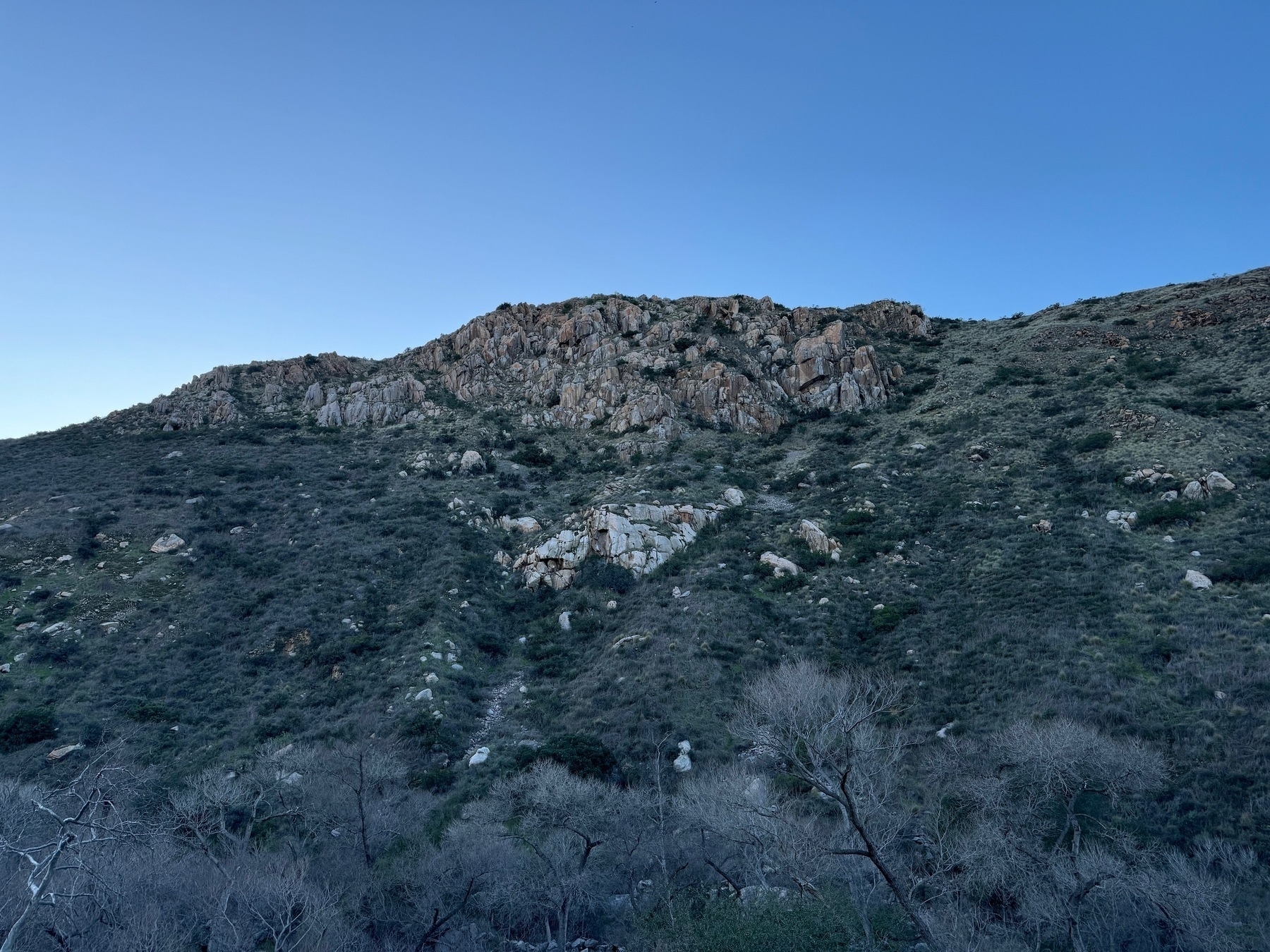
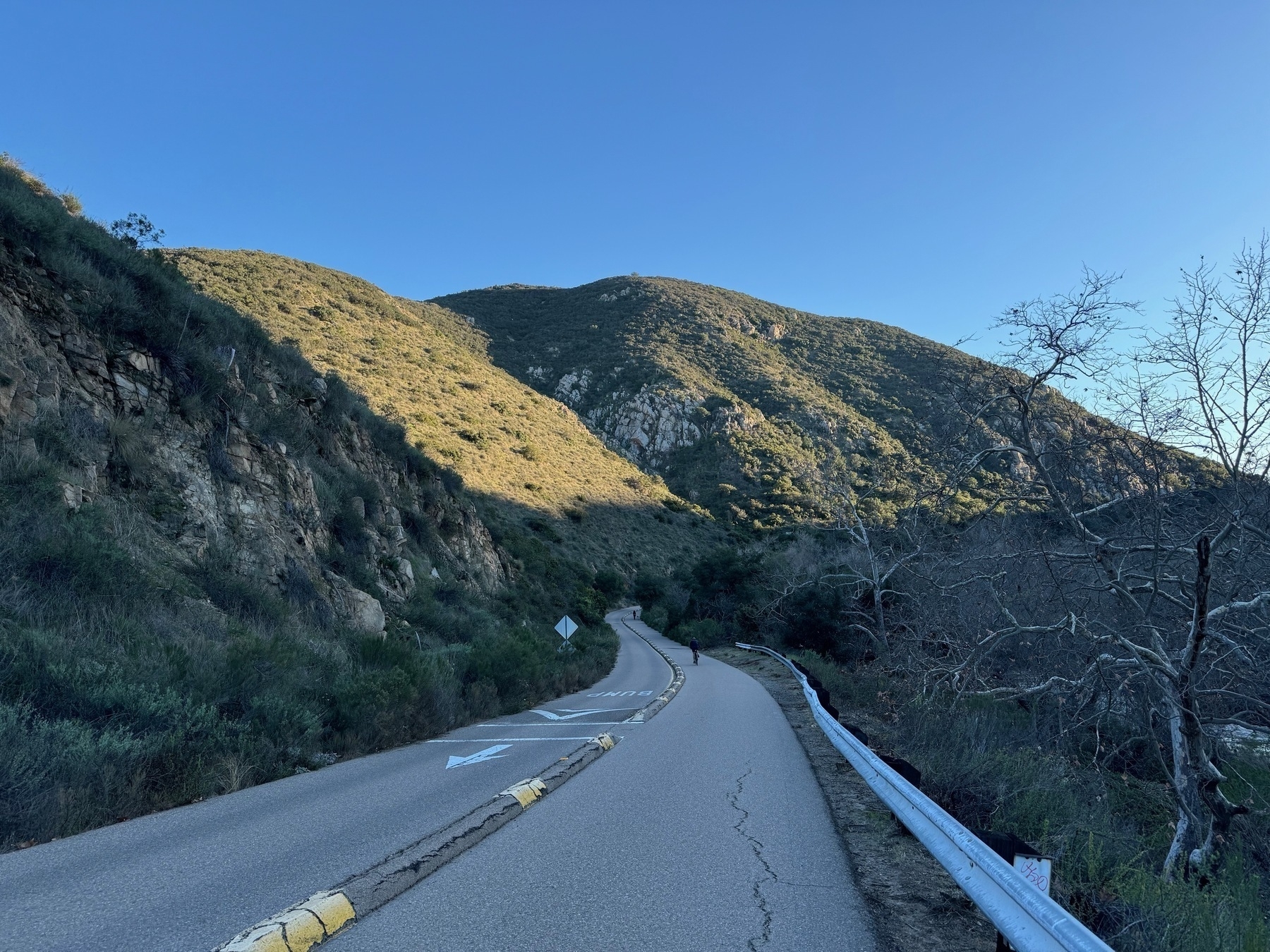
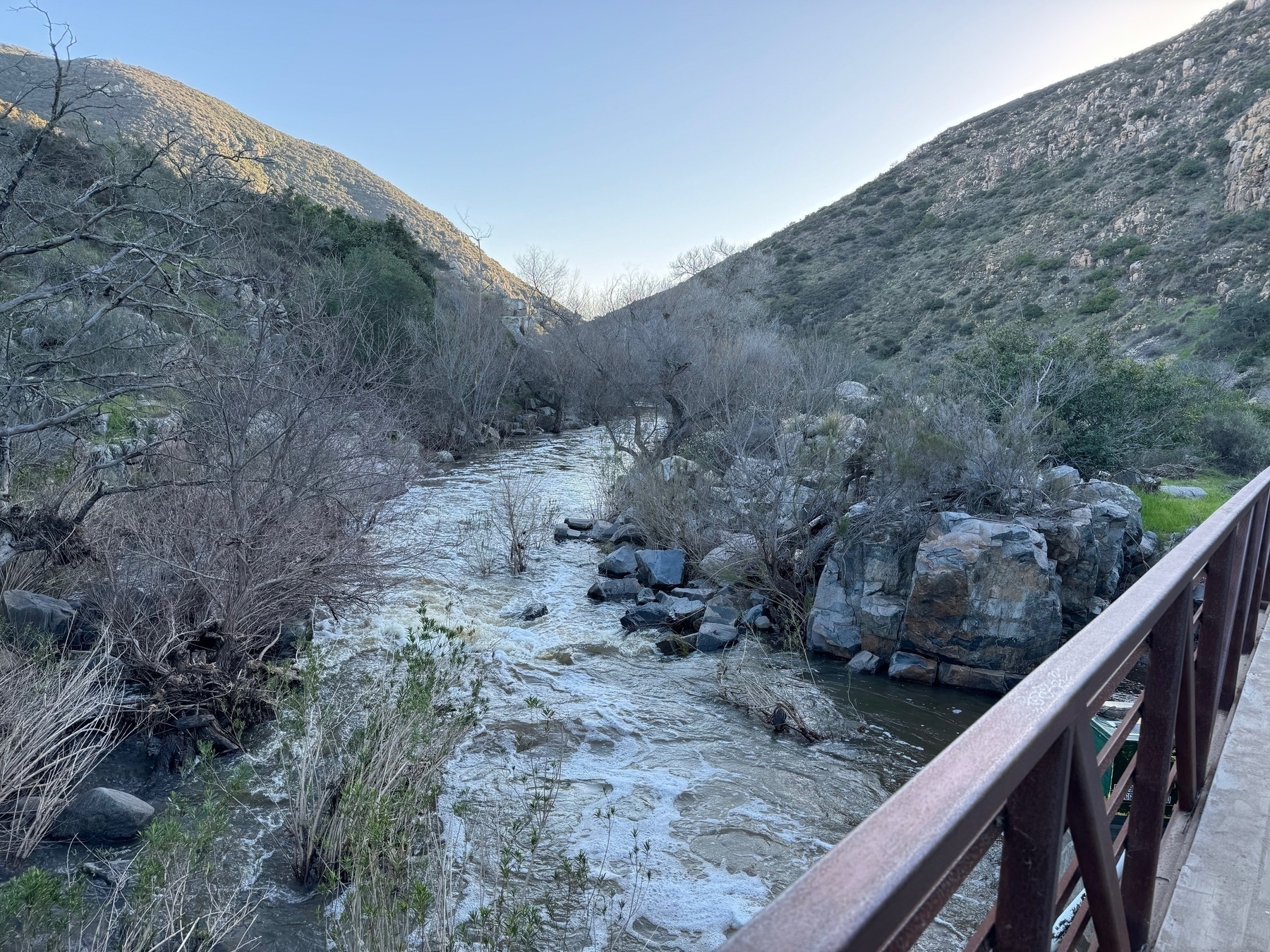
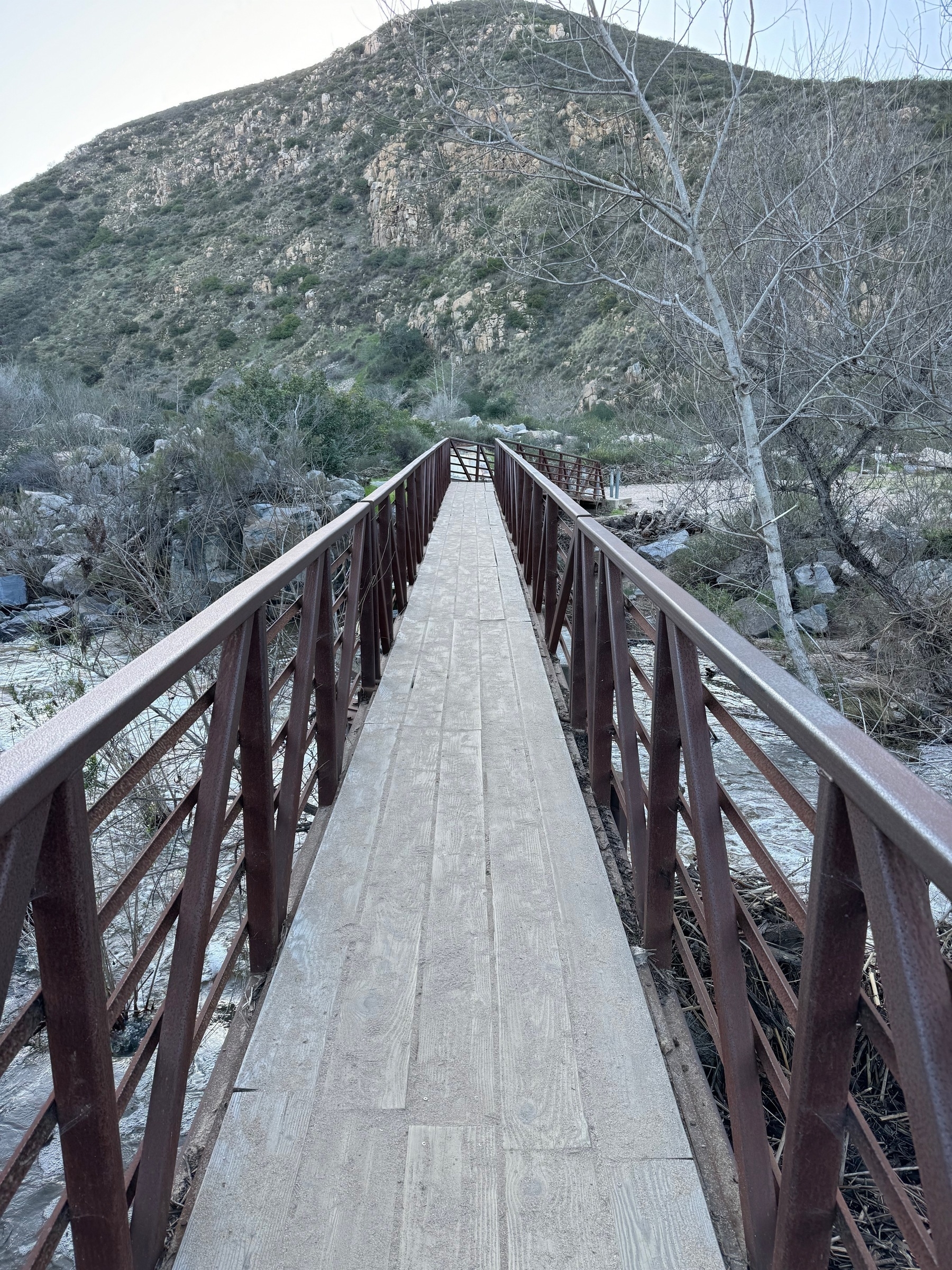
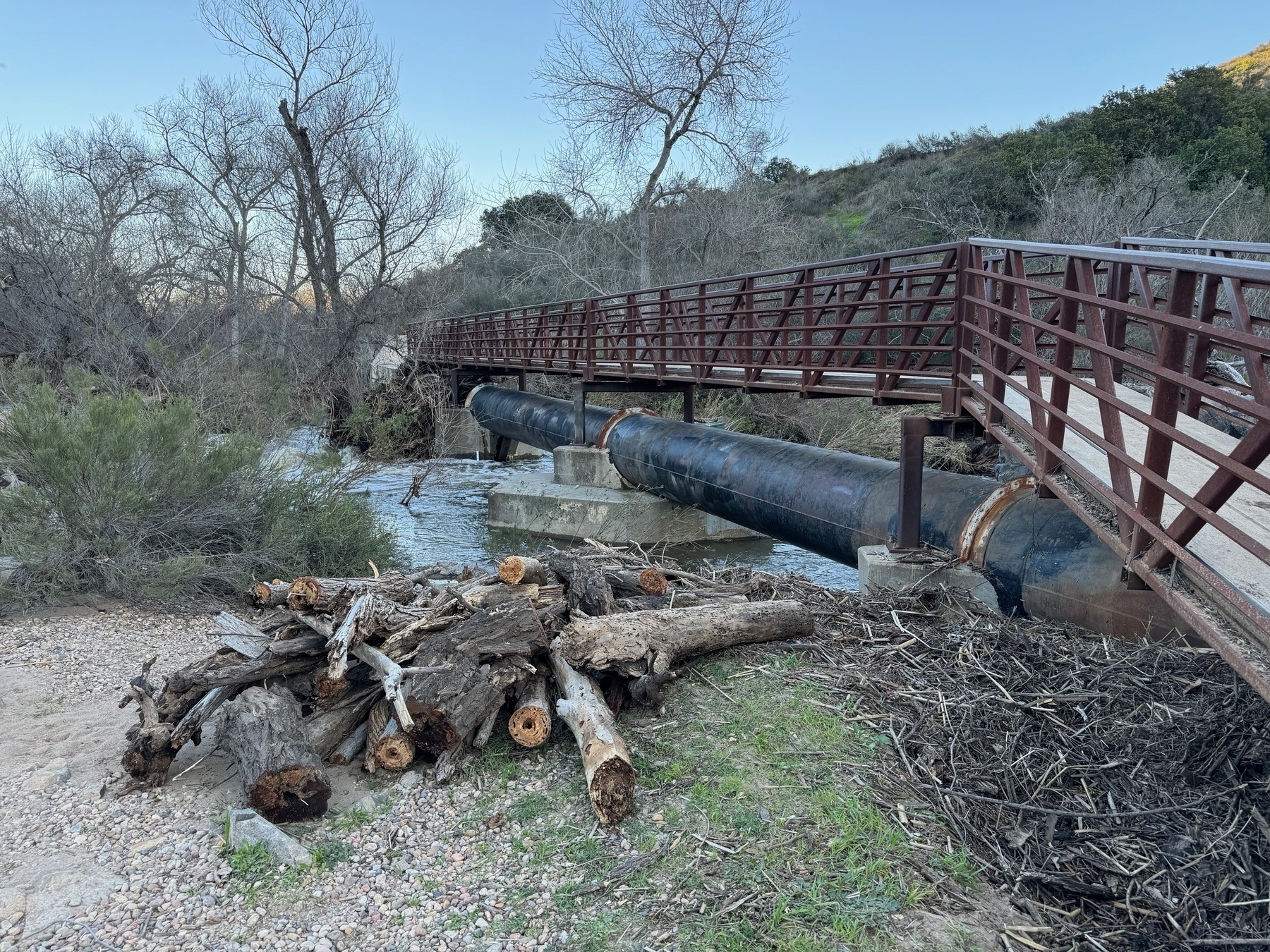
The dog and I walked part of Junipero Serra Trail yesterday at the Old Mission Dam.

Shakshuka is better than winning the Darwin Award

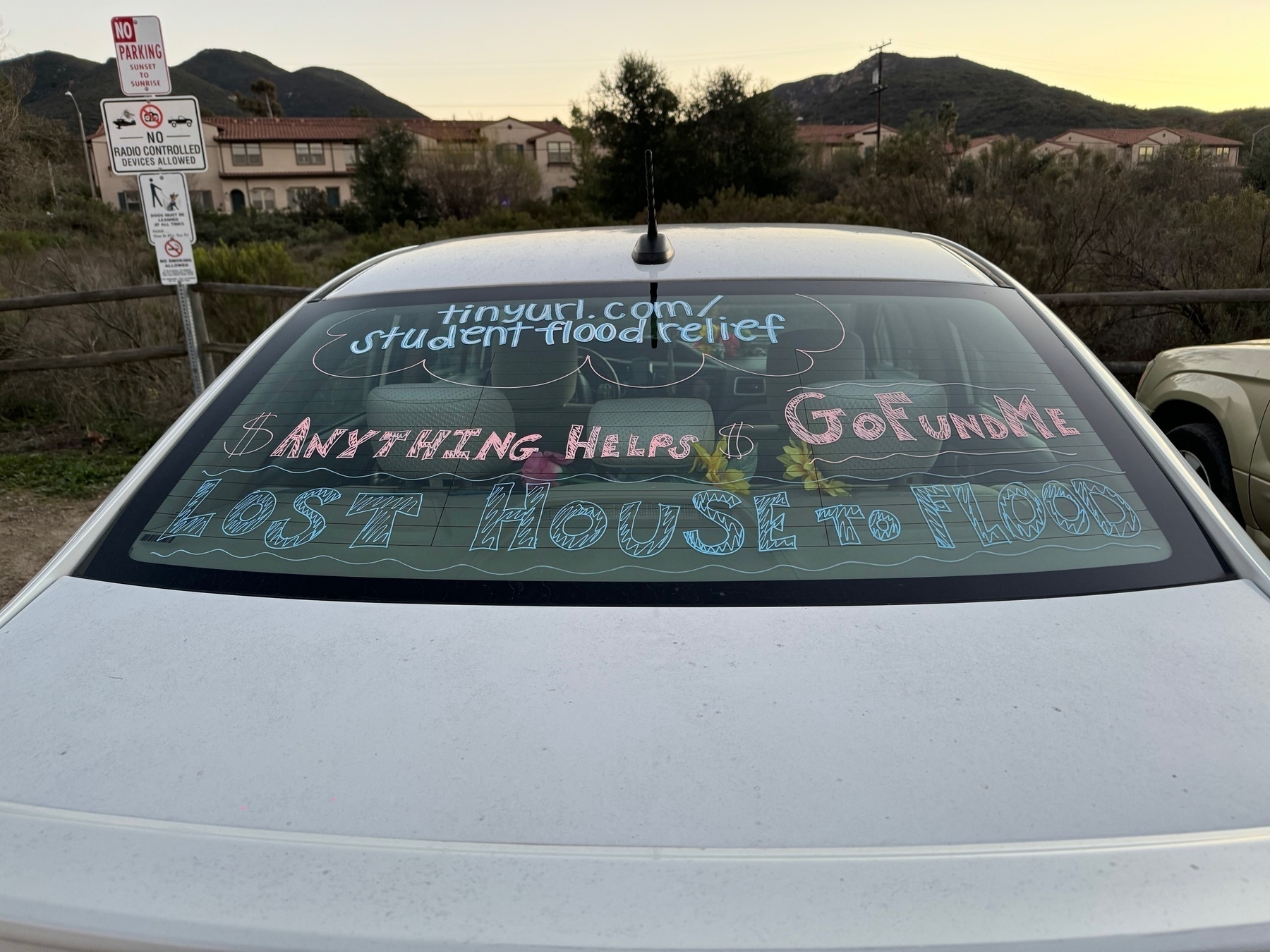
I had a meeting at 11 am at a local coffee shop. It’s been raining hard nonstop since Monday morning. This is not unusual back east, but it is unusual here, and because the drainage infrastructure isn’t built for it, it’s a cause for concern. We’ve had a lot of flooding. Not in my neighborhood—we’re fine—but elsewhere in San Diego, during another round of storms last week, cars were swept away and people had to be rescued.

I put on my rain jacket and hat and drove to the coffee shop. I got there about 20 minutes early. Every seat was full but that’s fine—I’m comfortable standing—so I stood there and drank my coffee.

A man wearing an Apple Vision Pro walked by me to approach the counter. When he walked by me the other way, I stopped him and I said, with no preamble or introduction, “Do you like it?” He knew what I was talking about, of course. He said he did like it. He said he edits video and he had two screens open and also his email. I said, “Now? While we’re talking? While you were at the counter?” He said yes. He was wearing the Vision Pro the whole time.

My meeting arrived a little early. A little more than half-hour in, every phone in the still-crowded coffee shop went off. We all looked at our phones. Tornado alert. Take shelter in a basement or somewhere away from windows. I happened to have gotten a table very far from the window, so I figured we were good.

I messaged Julie to check on her. She said she was going to get the dog and sit on the floor in the back hall, and try to get the cats too.

After a few minutes of no tornado, I thought about driving home. Could I beat the tornado? That seemed like maybe a bad idea, but on the other hand, I’m on a deadline today.

By now, it was after noon, and I decided to check and see what the place served for lunch. They had shakshuka. I love shakshuka. I thought about the options: Drive home during a tornado warning and not have shakshuka and maybe get killed and win a Darwin Award? Or stay in the coffee shop, have shakshuka, not get killed and not win a Darwin award? I went for the shaksuka option.

There was no tornado. It stopped raining. The shakshuka was delicious. The meeting was excellent. I left for home and arrived at about 1:15 pm. The sun was out, even though the forecast called for a solid wall of rain Monday through Thursday.

And that’s pretty much my day so far.

On the futility of blocking spammers on social media

People who spend a lot of time posting to social media often spend time going through their follower list and getting rid of the spammers and bots. I’ve never seen the point of that. As long as the bots aren’t interacting with my account, or otherwise getting in my face, I say let ‘em be. I have other things to do with my time.

No doubt many or perhaps most of my social media followers are bots. Doesn’t bother me. As long as I know real people are following my posts and enjoying them, that’s sufficient to keep me going.

I also distribute these posts via a newsletter. One day I checked the stats there and saw the newsletter had thousands of subscribers, and was growing fast. I was quite pleased.

Then a while after that I looked at the subscriber list and saw that many of those subscribers were bots. So I figured out how to prune the bots, and found that the actual number of human subscribers I had was 24.

Twenty four. Not 24,000 or 2,400. Two dozen.

Sad-face emoji.

The newsletter is up to about 26 subscribers now. But at least a few of those 26 subscribers seem to enjoy the newsletter, and it’s set-and-forget for me—runs automatically—so I’m happy to keep it going.

By the way, if you want to subscribe to the newsletter, you can do that here. Just think—your action alone can increase the subscriber base by nearly 4% and that’s quite an accomplishment!

The secret history of Napoleon Bonaparte: Watching “The Emperor’s New Clothes” (2002) starring Ian Holm

We saw “The Emperor’s New Clothes,” an idiosyncratic and charming historical romantic-comedy that starred Ian Holm and came out in 2002.

I liked the movie a lot. It exceeded my expectations. I thought it would be more broad and farcical than it actually was. It had a big heart, which I did not expect.

The premise: Napoleon, in exile on the island of St. Helena after his defeat at Waterloo, executes a scheme to escape and be replaced on the island by a double, a common seaman who looks exactly like Napoleon, whose name is Eugene Lenormand. Napoleon will settle in Paris incognito, and the false Napoleon will reveal his true identity, as will the true Napoleon. France will rally and the empire will be restored.

But the plan goes wrong, and Napoleon needs to survive in Paris as Lenormand.

Fortunately for Napoleon, he’s taken in by a pretty widow.

But Napoleon never loses hope, and never stops planning to resume his rightful place as emperor.

Meawhile, he and the widow fall in love. She thinks he’s just Lenormand, a commoner like her, maybe someone who once did prison time.

Holm plays both Napoleon and the sailor Lenormand. He gives two great performances. As Napoleon, Holm is commanding, striding about erect with his hands clasped behind him. And he’s also sad and brave as he adjusts to life without the trappings and luxury of power.

In an early scene, Napoleon, disguised as Lenornmand, commands his ship’s captain to change course immediately and head for France. Holm’s performance is appropriately imperious, and you can easily imagine that underlings would be terrified to receive a command like that from the emperor. But now Napoleon is living the life of a common deckhand, and the ship’s captain just laughs at him.

Later, Napoleon marshals the same charisma to inspire rather than intimidate, and succeeds in rallying a band of struggling street vendors to sell fresh fruit.

Meanwhile, on St. Helena, the false Napoleon is enjoying his captivity. It’s a prison, but it’s posh and luxurious, with fine food, beautiful art and clothing, and servants to tend to Lenormand’s needs. In character as Lenormand, Holm is boorish, gluttonous, drunk and loud. His scenes are played for low comedy.

Iben Hjejle plays the widow, whom everybody calls “Pumpkin.” She’s a Danish actor, probably best known to American audiences for appearing as John Cusack’s girlfriend in “High Fidelity.” Pumpkin is your basic romantic-comedy woman’s role; she’s an auxiliary to the man. Her job is to look beautiful and adore Napoleon (whom she knows as Lenormand). Hjeile does the job. I’d like to see her in a real role sometime.

The magic of “The Emperor’s New Clothes” is that it commits to the bit. It takes its premise seriously.

As Roger Ebert noted in a 2002 review, you can easily imagine the movie going in a broad, Monty Python direction, but instead, “The Emperor’s New Clothes” is “a surprisingly sweet and gentle comedy.”

The dialogue and acting are first-rate, and the costumes and settings are up to the standards of any historical drama.

I was intrigued by “The Emperor’s New Clothes” because of a mention the movie got on the Age of Napoleon podcast, an extremely detailed history of the life and world of Napoleon, which has been running for seven years and isn’t anywhere near done. I’ve been listening to the podcast for several years.

The host, Everett Rummage, said he thought “The Emperor’s New Clothes” was the only movie that he ever saw that truly captured Napoleon’s character. This was before the current Ridley Scott movie came out.

Having now seen “The Emperor’s New Clothes,” I can absolutely see Rummage’s point. Granted, pretty much everything I know about Napoleon comes from Rummage’s podcast. But we know that Napoleon started as a minor nobleman in Corsica, went to French military school and quickly soared through the ranks during the Revolution. Napoleon was arrogant, but he also had a common touch. He was a democrat with a small “d,” unimpressed by aristocracy and valuing talent, character, and loyalty over inherited titles. He slept on the ground with his men in battle, gave them personal attention, and they loved him. We see all these qualities in “The Emperor’s New Clothes.” When the fictional Napoleon is required to scrub decks, sleep in a barn and rub elbows with street vendors, well, we can imagine that Napoleon had experience with that kind of thing.

In reality, Napoleon was a genius. He was an enlightened ruler who swept aside the old order and instituted more egalitarian forms of government that are influential to this day. He nurtured science, scholarship and the arts.

And Napoleon was also a bloodthirsty murderer, tyrant and monster who bathed Europe in blood and re-instituted a regime of brutal slavery that Haiti still has not recovered from more than two centuries later.

We only see the good side of Napoleon in “The Emperor’s New Clothes.” His evil is dealt with in a single line of dialogue. Which is as it should be in this particular movie.

The movie is loosely based on a novel by Simon Ley, “The Death of Napoleon.” Writer Peter Hicks compares the two. Hicks says the book is “a sustained elegy on the wisdom of recognising the important things in life, such as love, happiness, modest success,” which are far more important than the “chimaeras of power and military glory.” The movie has the same theme. As Ebert says, Napoleon gradually realizes that “the best of all worlds may involve selling melons and embracing Pumpkin.”

In an afterword to a 2006 edition of the book, Leys said the movie “was both sad and funny: sad, because Napoleon was interpreted to perfection by an actor (Ian Holm) whose performance made me dream of what could have been achieved had the producer and director bothered to read the book."

Based on Hicks’s description, I think I would prefer the movie and I am not tempted to read the book.

P.S. Hugh Bonneville, who stars “Downton Abbey” as Robert Crawley, plays a supporting role in “The Emperor’s New Clothes.” I didn’t recognize him.
For a long time, I defined myself by my work

That was fine when I was in my 20s, but it became less and less useful. I stayed with it anyway, well past the point of uselessness.

I also defined myself more broadly as a writer. But that doesn’t work for me either. I still write—look, I’m writing right now!—but it’s not who I am.

I’m an American, Californian, Jewish, white, male, cis-gendered, heterosexual and Julie’s husband. Those things are characteristics. They’re not who I am.

Maybe we don’t need to define ourselves. Maybe it’s enough to just be and do.

I observed with interest the recent meme by young women who were amazed to find the young men in their lives thought about Rome often.

I certainly think about Rome often, though I am not a young man—I am a man in the period of life I like to call “early late middle age.” I never thought thinking about Rome was remarkable.

I’m not sure I should be considered part of the meme because I’m a history buff, and one of the historical periods that interests me is Rome. History is a hobby for me, and I think about history a lot.

On the other hand, maybe that makes me a big part of the meme.

Historian Patrick Wyman has a theory on why people (of every and all genders) are fascinated by Rome today. It’s a good theory and now I think I need to subscribe to his podcast and read his books.

And Ryan Broderick has a theory why this meme is becoming popular now:

Every 5-7 years, a whole bunch of people come of age online at the same time. Their dumb, usually playful freshman-dorm-icebreaker-level content and discourse is then pored over by media outlets and turned into these big news cycles that inevitably sour. But I think it’s just kids making sense of the world around them. It’s fun and sometimes reveals some interesting quirks about society, but it doesn’t always — and, I’d argue, rarely does — matter.

A note to my fellow Jews, particularly Jewish-Americans

Do you feel any connection to the place where your grandparents came from?

My grandparents came from Eastern Europe. Poland on my father’s side, and Lithuania on my mother’s. But I do not feel like a Polish-American or Lithuanian-American. I’m just plain American. Or a Jewish American.

I suspect this is because my grandparents left those countries to get away from anti-Semitism, and found a welcoming home here. I have had the good fortune to be born in one of the few places and times in history where Jews face very little anti-Semitism. No wonder I’ve never won the lottery—I used up all my luck when I was born.

New York occupies the place in my heart where other people put their ancestral affinity. I’m an expatriate New Yorker, the way some people are Italian-American or Irish-American.