
We are five episodes behind on Succession, and I am wondering if I have the willpower to avoid news and social media Sunday and Monday, to avoid series finale spoilers.
“I tried the AI novel-writing tool everyone hates, and it's better than I expected”
Last week, generative fiction tool Sudowrite launched a system for writing whole novels. Called Story Engine, it’s another shot in the ongoing culture war between artists and AI developers — one side infuriated by what feels like a devaluation of their craft, the other insisting that it’s a tool for unlocking creativity and breaking writer’s block. Neither answered the question I was really curious about: does it work?
Well, I didn’t take on Sudowrite’s pitch of a full novel in a few days. But over the weekend, I generated a novella written entirely inside Story Engine — it’s called The Electric Sea at the AI’s suggestion, and you can read the whole thing on Tumblr.
I’m not sure how I feel about it.
I’m an enthusiastic, if strictly amateur, fiction writer. I wrote somewhere north of 150,000 words of unpublished fiction last year, so Sudowrite’s “break writer’s block” pitch isn’t that compelling to me. Writing, however, is not a task I hold inherently sacred. The field has a long and proud tradition of hastily written profit-driven trash, from Ed Wood’s churned-out erotica to the infamous pulp publisher Badger Books, known for handing authors a cover and asking them to write a book around it. I enjoy seeing where large language models’ strengths and weaknesses lie, and I’ve long been fascinated by challenges like NaNoGenMo, which asked writers to create an AI-generated novel in the days before modern generative AI. So on Saturday morning I paid for 90,000 words of Sudowrite text, booted it up, and “wrote” a roughly 22,500-word cyberpunk novella by Sunday afternoon.
One of my favorite novels deals with the world of “hastily written profit-driven trash:” “Derby Dugan’s Depression Funnies,” by Tom DeHaven, about a hack writer in the 1930s who churns out pulp stories and comic strip text. I wrote about it here. (“‘Derby Dugan’ is a wonderful novel,” I said. “I like to re-read it every few years to revisit a time and place where a kid in a yellow derby with a talking dog can make a writer a star of an enchanted New York.” Which reminds me that I haven’t re-read the Derby Dugan trilogy in some time.)
Robertson:
Writing is a pastime I enjoy, and it’s led me to a lot of fascinating places, even when the end result won’t be sold or even read by anybody else. I’ve taken up entire hobbies and vacations for research purposes. I like devising a good turn of phrase or exploring a character’s motivations. I enjoy feeling like I’ve done something a little unexpected or, conversely, like I’ve written a spot-on pastiche of a style. I don’t care about an AI “replacing” me the way I don’t worry about an industrial knitting machine replacing my handmade shawls — the process is the point.
I need to think about that. I started my journalism career on daily newspapers, where I loved doing weird things that I would not do on my own initiative: playing paintball, flying in an ultralight aircraft, or—in college—going out with the campus police on an all-night ridealong. I talked with a lot of strange characters too. Tech journalism and marketing is a great career, but I miss that other thing.
Spoiler: Robertson finds the software writes a barely passable, mediocre, cliched cyberpunk novella. I think she’s being charitable. I think it stinks—but I’m not a cyberpunk fan. Still, it’s a functional novella, she says.
I find the same thing with ChatGPT, when I’ve tried it on articles. It’s bad, like SEO spam. But there’s demand for SEO spam.
I wrote this: Red Hat brings AI to IT operations. Red Hat is putting artificial intelligence (AI) to work in IT operations and event remediation, showing the technology is good for more than designing novelty socks or creating an endless Seinfeld parody.
Jealous of other people's excellent videoconferencing backgrounds
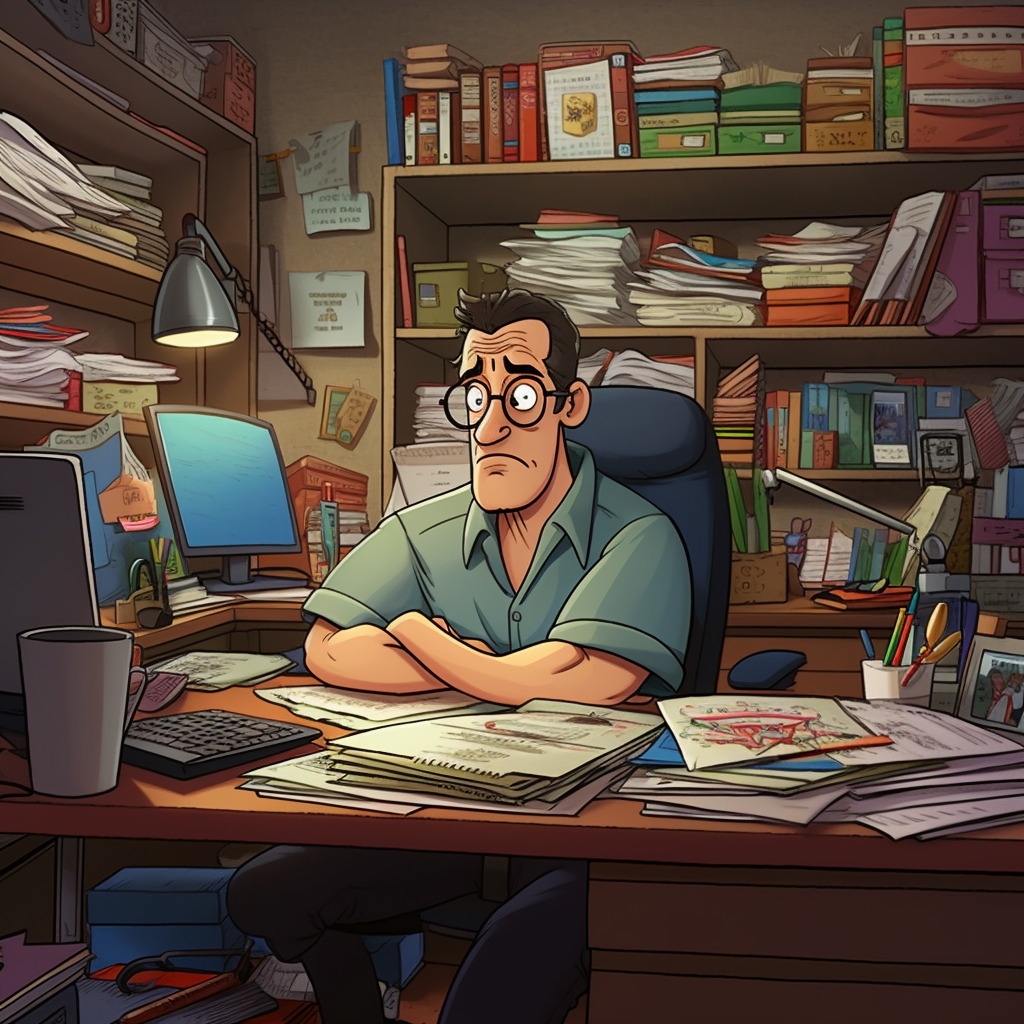
I have an expanse of blank white wall behind my desk, which always bugs me when I see myself on Zoom calls. This has been a stone in my shoe for three years since videoconferencing became commonplace. I’m jealous when I see other people have excellent backgrounds for their Zoom calls.
A friend suggested I just get a couple of guitars and put them behind me. “But I don’t play guitar,” I said. “Doesn’t matter,” my friend said. “Anybody asks, you just make a sad face and say, ‘Oh, I just don’t have time to play anymore.’”
I found a local shop that sells movie posters, with a focus on midcentury grindhouse horror movies. Having a poster for “The Texas Chainsaw Massacre” hanging behind me for business meetings would definitely send a message.
I wrote: Red Hat secures the software supply chain. Red Hat unveils Trusted Software Supply Chain, which tracks where open-source components come from and whether they are trustworthy to “provide customers with the added assurance that the bits they are deploying are safe and secure.”
Oracle’s Larry Ellison gears up to spend millions to back Tim Scott’s 2024 run. Of interest to my Oracle pals.
From what I saw working there two years, the culture within Oracle is extremely progressive. Inclusive, good benefits, supports environmental causes.
On the other hand, Larry Ellison himself is very conservative. He supported Trump and now this.
An odd juxtaposition.
Ray Stevenson Dead: ‘Punisher: War Zone,’ ‘RRR’ Actor Was 58. I’m sad to hear it. To me, he’ll always be Titus Pullo, the lovable cuddly murderous psychopath from “Rome.”
I can proofread my article or generate a cool Midjourney image to accompany said article. Gee, tough decision. Do I want kale or chocolate cake?
If the Apple VR/AR headset debuts, and it’s as described in leaks, it’s going to be the biggest flop in Apple’s history and one of the greatest tech flops ever.
Nobody’s interested in wearing a Batman mask all day.