
I asked ChatGPT to create an image of a spider-cat with big bat wings. It came out great. I don’t think you want to see it. You probably wish I hadn’t told you about it.
Writer Zadie Smith and journalist Ezra Klein on connections between a 19th Century British huckster and Trump, emotions vs. rationality, wokeness, identity, how social media and other online spaces “seriously modify” our minds, loneliness and more
Smith and Klein discuss her recent novel “The Fraud,” which is based on the Tichborne trial, a real incident in 19th Century Britain where an Australian butcher claimed to be the heir to the rich estate of an English nobleman who had been lost at sea. The British working classes flocked to support the butcher, even though he was obviously a fraud.
Klein writes:
I didn’t expect this novel about a trial in 19th-century London to be so resonant with 21st-century America. But Smith has said Trump and populism were front of mind when she wrote it, and you can feel it in the book, as she explores the Tichborne trial. [The butcher] built a huge movement of passionate supporters who utterly flummoxed the day’s elites.”
The discussion goes a long way toward explaining Trump’s appeal, which baffles me because Trump is obviously not the man he claims to be, or that many of his supporters claim him to be. Trump is obviously a failed businessman, reality show star and disaster of a President who left the economy in tatters and hundreds of thousands dead. But his supporters lap up his act — just as 19th Century English people did for their fraud.
Klein and Smith also talk about the role of emotion in politics — how rationalists scoff at emotion (“facts don’t care about your feelings”) but in fact, emotions are a valuable guide to thinking.
Also, on “wokeness,” Smith says:
I just don’t even recognize the category. If I’m teaching “Pride and Prejudice,” it’s not a battle between woke thought and unwoke thought. I’m only interested in truth.
To me, there is no friction and no battle between teaching the beauty and artistry of Austen’s novels – discussing where Darcy’s money comes from, which is most certainly the Caribbean, understanding the political situation in England in the 1810s. Those things happen simultaneously. The working-class movement, which is off to the side in that novel, the complacency of the middle classes in that novel, the artistry of Jane Austen.
I don’t take the bait. I don’t accept the argument in the first place that I have two kinds of students who are in some kind of football game of ideas, and if one wins, the other loses. That’s not how I teach literature. That’s not how I think of history. That’s not how I think of the relationship between Black and white people. So I don’t engage, because I think it’s a bait and that what you’re meant to do in response to it is move further and further to the right in response to this boogeyman.
This is exactly how I approach old movies and novels. I disagree with Smith on a minor point: There is friction, but it’s part of the experience. (My interests are less highbrow than Smith’s. I watch old Hollywood movies and re-read midcentury science fiction. Midcentury American pop culture was far more segregated and gender-defined than today, and it’s reflected in the pop culture of the period.)
Much of what we label “wokeness” is “people who thoughtlessly considered themselves at the center of history, culture, would be made to look at the world another way,” Smith said. In other words, in the West, being a white man was default, and everybody else was different. Now, everybody is different, and some folks who were accustomed to being the default are struggling with the change.
Klein alludes to a point he’s made in the past — that when we bemoan divisiveness and identity politics and yearn for a return to a time of harmony, we’re forgetting that in the past we had consensus because many people were simply left out of the room. Congressional representatives got along with each other because they were almost all older white men.
Smith notes that people are multi-dimensional. The “straitjacket” of identity politics is “something that nobody really wants. Sometimes it’s needed politically. We absolutely need to gather in our identity groups sometimes for our freedoms, for our civil rights. There’s absolutely no doubt about that.” But most of the time, we want to be ourselves.
And those multiple dimensions are a balm for polarism, because we often find common ground even with people of other races, religions, sexuality, etc.
Smith talks about how social media and smartphones change who you are. She and her husband do not have smartphones and she says she’s happier for it.
When you wake up in the morning and you turn to your social app, you are being instructed on what issue of the day is what to be interested in. The news has always played some element in doing that, but this is total. And it’s not even, to me, the content of those thoughts. There’s a lot of emphasis put on the kind of politics expressed on these platforms to the right or to the left.
Social media drives us to think there are two and only two sides to every argument, the right and left, and they must be in conflict with each other.
I keep thinking about a comment my Congressional representative, Sara Jacobs, has made at least twice that I know of. She is far Left — which is a big part of why I support her. She divides her Republican colleagues into two groups: Those who are interested in governing, and the others. She says she gladly works with conservative Republicans who are interested in governing, and often finds common ground with them.
Smith says that everybody who went online in 2008 has been “seriously modified” by technology.
And that’s OK. All mediums modify you. Books modify you, TV modifies you, radio modifies you. The social life of a 16th-century village modifies you. But the question becomes: Who do you want to be modified by, and to what degree? …
And when I look at the people who have designed these things – what they want, what their aims are, what they think a human being is or should be – the humans I know and love, this machinery is not worthy of them. That’s the best way I can put it.
And I speak as someone who grew up as an entirely TV-addicted human. I love TV. I love reading. Modification is my bread and butter. And when the internet came, I was like, hallelujah. Finally, we’ve got a medium which isn’t made by the man or centralized. We’re just going to be talking to each other, hanging out with each other, peer to peer. It’s going to be amazing. That is not the internet that we have. That is not what occurred.
I’m skeptical of individual technological solutions for the ills of being online. (With one exception: Keep notifications to a minimum. You don’t need to be notified of Facebook comments, etc., when you’re not in the app. Switch 99% of your smartphone notifications off.) Getting rid of smartphones won’t make us better people.
Klein recommends Marshall McLuahan and Neil Postman, “media theorists from the rise of the television age.”
And the things they were saying television would do to us and do to our culture are right. There’s a straightforward argument in Neil Postman’s great book, “Amusing Ourselves to Death,” where he says that the thing television is going to do to politics is make us believe politics should always be entertaining, and that’s going to make politics a space dominated by entertainers. And like here we literally are, with a reality television superstar running for president, having already been president once before. For better and for worse, they saw it all coming, and they described a world way less warped and deranged by all this than the one we actually live in. If you went back and told them what happened, I think they would look at you with their mouth agape.
And that is perhaps a part of Trump’s success. His supporters don’t support the man. They support the character he plays. Or the character that they perceive him to be playing. It’s like a cult TV show where the lead actor is bad but the fans love the character anyway.
Additionally, Klein and Smith talk about loneliness and aging, and how that’s particularly hard for men. Klein reads a passage from Smith’s novel, “The Fraud,” where one of the characters, Eliza, thinks at the end of her life: “When she was young she had wanted to know everyone, touch everyone, be everyone, go everywhere! Now she thought that if you truly loved – and were truly loved by! – two people in your lifetime, you had every right to think yourself a Midas.”
In 2017, Robbie Tripp posted an over-the-top message on Instagram about how much he loves his “curvy wife,” Sarah. “There is nothing sexier than this woman right here. Thick thighs, big booty, cute little side roll, et cetera,” he wrote.
Podcaster Jamie Loftus tells the story of the post and the wave of Internet discourse that followed.
Loftus explains that Robbie is an example of an Internet character called “the wife guy”—someone who doesn’t just proclaim his love for his wife online, but someone for whom “telling people how much he loves his wife appeared to be part of his job.”
The Tripps are both Internet influencers and content creators, and Robbie, at least, has built a little media business on the “curvy wife” meme.
My thoughts about this are complicated. It’s very hard for me to avoid judging the Tripps harshly — which is wrong of me. Loftus sums it up: “Pathologizing someone else’s marriage is 10 miles of none of your fucking business.”
Loftus does wonderful podcasts on odd corners of culture. This episode is part of a series about people who become Internet-famous — the “main character” of social media — for a short time, and lived with the repercussions for years, for better or worse. Loftus tells their human stories. The series is called “Sixteenth Minute of Fame.”
Another Loftus podcast, “The Lolita Podcast,” looks at the Nabokov novel, which she describes as basically a horror novel about a pedophile who destroys a young girl’s life. But the novel lives on as creepy erotica, with the girl portrayed as predator rather than victim, turning us all into Humbert Humbert.
Another great podcast by Loftus: “My Year in Mensa.”
The awful reign of the Red Delicious apple
It lurks in desolation. Bumped around the bottom of lunch bags as schoolchildren rummage for chips or shrink-wrapped Rice Krispies treats. Waiting by the last bruised banana in a roadside gas station, the only produce for miles. Left untouched on hospital trays, forlorn in the fruit bowl at hotel breakfast buffets, bereft in nests of gift-basket raffia.
— Sarah Yager at The Atlantic
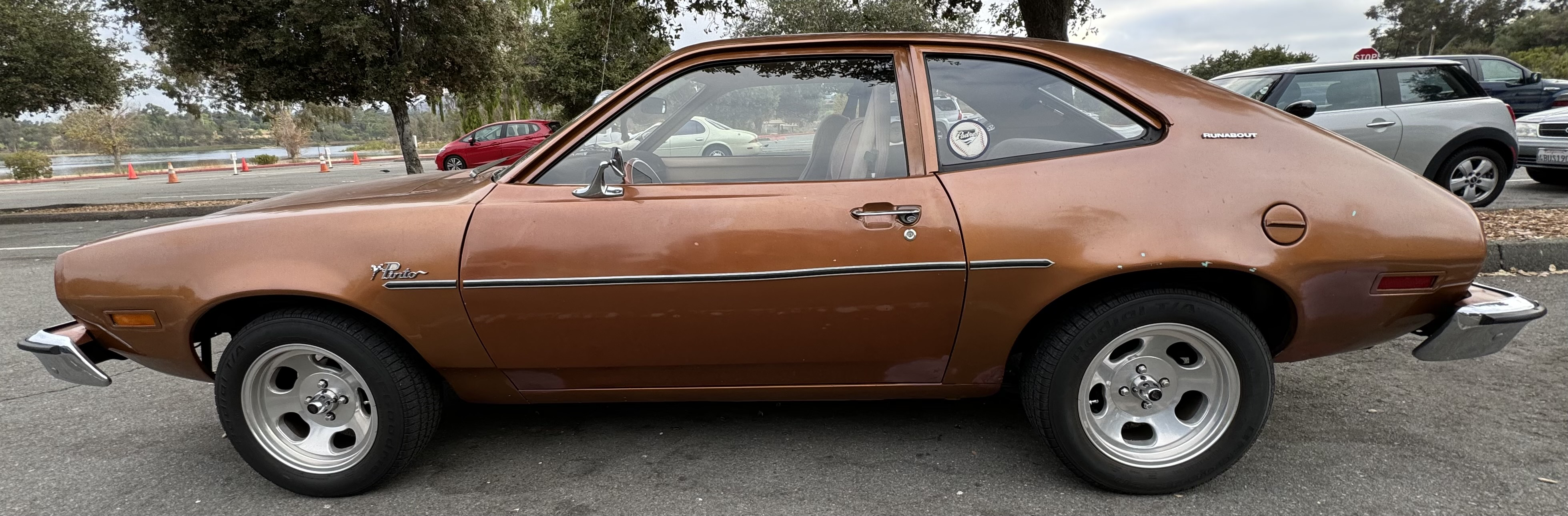
Something I saw while walking the dog: I have seen this Ford Pinto parked at the Lake Murray parking lot dozens of times over the 10+ years that I’ve been walking there. I finally saw it drive in, and a woman got out from behind the steering wheel, so I had an opportunity to talk with her and find out more about the car.
She and her husband have owned the car for 50 years. They bought it new in March 1974, and she says it is very easy to maintain.
I found it surprisingly easy to resist temptation to make the obvious Ford Pinto joke.
She also volunteered that she would never buy an electric car. The batteries need replacing after five years and are exorbitantly expensive, she said.
Crystal met Hugh Hefner when she was 21, and he was 81. They were married three years later and spent 10 years together at the Playboy Mansion before he died, and she became a widow. “I definitely was financially and emotionally abused by Hugh Hefner… I didn’t have the tools back then to even survive.”
Paraphrasing a line from “Batman: The Dark Knight:” You either die a glamorous playboy or you live long enough to become a weird, creepy old letch.
The Death, Sex & Money podcast: Life and Death Inside the Playboy Mansion
I’m looking for an app to set a reminder that repeats hourly after completion. Plenty of apps offer reminders that repeat daily, weekly or monthly after completion, but I haven’t been able to find even one that will repeat hourly. Anyone?
I was about 20 years old when I saw “All That Jazz” and I loved it. I wanted to be Roy Scheider’s character — I envied his commitment, passion and charisma.
For years I wondered whether I had missed the point of the movie, but it occurs to me now that I got the point of the movie. The life that Scheider’s character lives is seductive. A deal with the devil only works if the devil offers you something that is supremely alluring.