
My Favorite Times to Use Incognito Mode (The New Yorker / Jade Orlando) A fun one-minute read.
Watching RoboCop on the Spanish language channel while getting a haircut. You really lose out on the emotional subtlety and nuance when you can’t understand the dialogue.
How to Win at Monopoly and Lose All Your Friends.
Monopoly starts as a fun exciting romp, only to turn into a bitter cesspool of despair.
…
A little-known rule of Monopoly is that the game has exactly 32 houses and 12 hotels. Once you run out of houses, no more can be purchased until they re-enter the supply by being sold or upgraded to hotels. … The core of this strategy is to buy up as many houses as possible before anyone realizes what you’re doing, and DO NOT UPGRADE TO HOTELS to prevent people from improving their own properties.
…
If losing a normal game of monopoly is frustrating, losing to this strategy is excruciating, as a losing opponent essentially has no path to victory, even with lucky rolls. Your goal is to play conservatively, lock up more resources, and let the other players lose by attrition. If you want to see these people again, I recommend not gloating, but simply state that you’re playing to win, and that it wasn’t your idea to play Monopoly in the first place.
The Onion: It Is Journalism’s Sacred Duty To Endanger The Lives Of As Many Trans People As Possible “It’s about asking the tough questions and ignoring the answers you don’t like…. “
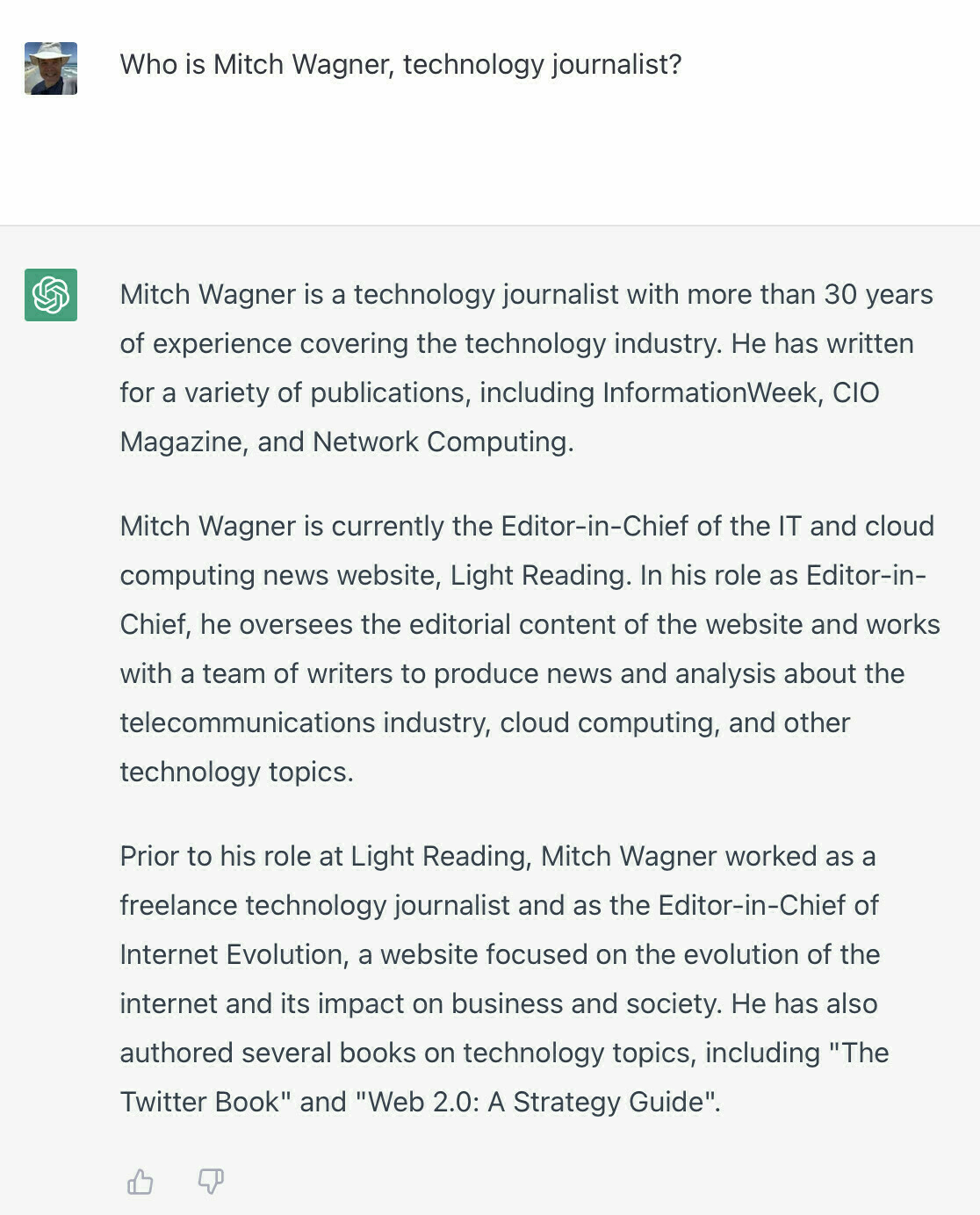
I asked ChatGPT for my bio. The result has a staggering number of errors packed into a small space. I never wrote for CIO Mag or Network Computing. I am not now and never was EiC of LR, which is not best described as an IT and cloud computing website. I did not write those books. And so on.
TurboTax parent Intuit is stepping up lobbyist spending to stop Washington from simplifying taxes. (OpenSecrets.org / Anna Massoglia)
Simplified taxes would hurt Intuit’s bottom line.
Picard rummages through a trunk, searching for the source of the sound of an Enterprise-D commbadge chirp. He tosses the contents one at a time over his shoulder: Tennis racket, bowling shoes, harmonica, clown nose, groucho glasses, rubber bulb horn (which he squeezes twice: honk! honk!), feather boa. He unscrews the lid from a canister labeled “cocktail peanuts” and rubber snakes spring out…..
On Lake Murray: This metal platform is usually attached to the concrete walkway, and people fish from it. It came loose in the storms this week.


A little while back I heard about a conspiracy theory claiming the Roman Empire didn’t exist–that it’s a hoax promulgated by the Spanish Inquisition, which happened in the 15th Century.
I learned that it isn’t really a fully-blown conspiracy theory, which to me implies a movement. It’s just this one popular TikToker, who goes by the handle @momllennial_, and she also has claimed that Alexander the Great was a woman, and Jesus Christ’s name can be translated as “clitoris healer.”
2021: This TikTok Conspiracy Theory Is Infuriating Historians (Daily Dot / Gavia Baker-Whitelaw)
Bruce Willis has been diagnosed with dementia, his family announced. Last year, they announced Willis was retiring from acting due to aphasia. (CNN)
Sad and troubling news. I’m a fan, and he’s not that much older than I am.
Stifling Free Speech Is Now A Core Plank Of The Republican Platform (Mike Masnick / Techdirt) Clarence Thomas, Devin Nunes, Sarah Palin, and Ron DeSantis support laws that would enable politicians to harass critics with punitive lawsuits.
Cory Doctorow:
The really remarkable thing isn’t just that Microsoft has decided that the future of search isn’t links to relevant materials, but instead lengthy, florid paragraphs written by a chatbot who happens to be a habitual liar – even more remarkable is that Google agrees.
Also:
Every successful Google product except search and gmail is an acquisition: mobile, ad-tech, videos, server management, docs, calendaring, maps, you name it. The company desperately wants to be a “making things” company, but it’s actually a “buying things” company.
The last time Google went into full-on panic mode, the result was Google+, which was actually a great product that Google bungled spectacularly.
Honestly, I don't need reporting to the Social Media Mental Health Police
I received this message when I logged in to Facebook just now, and I find it sweet (aww, somebody is concerned), ridiculous (I’m fine, aside from the normal amount of stress from living in the 21st Century) and creepy (Facebook, you’re not my Mom).
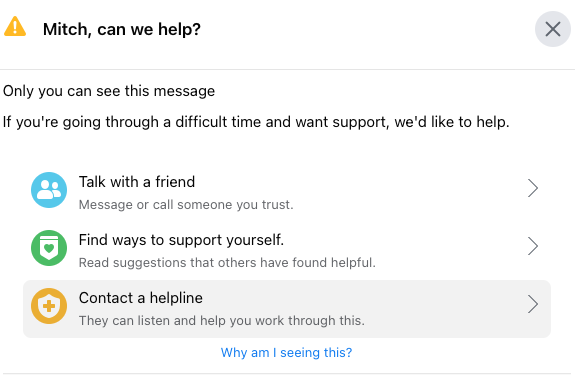
According to the explainer, the message comes up when someone has flagged one of my posts as concerning, involving self-harm or suicidal thoughts. None of which I am remotely having or sharing.
I received a similar message a few months ago, on Reddit, where I rarely post, though I do read and upvote a lot.
WTF is going on here? Are people misinterpreting my posts? Are Facebook and Reddit algorithms reviewing my activity and finding my interest in memes and vintage photos disturbing? Why am I not getting these messages on Tumblr, micro.blog, or Mastodon—do those platforms not love me?
The FTC wants to ban non-compete contracts, which are exploitative and unfair to workers. (Steven J. Vaughan-Nichols / Computerworld)
Workplace coffee gets weird and ugly. the $15,000 coffee fund, the cheapskate executives, and other stories of office coffee wars (Ask a Manager)
I went indy three weeks ago and since then I’ve had many discussions about about potential full-time and freelance opportunities.
Pluses:
- Exciting new opportunities
- Income means we can buy proper food and not have to eat the dog or cats.
- Videoconferencing shirt is getting a good workout.
Minus:
- I have to shave every day.
Teaching generative AI to give factual answers is going to prove as difficult as teaching it to write credible answers has been.
Even human beings have difficulty distinguishing information from bullshit on the Internet. We can’t even agree which is which.
I’m continuing my project of relearning how to read books. Remembering that as a voracious teenage reader, I would discover an author and read everything I could find by him, until I was caught up or had at least read everything by that author in the local mall bookstores and libraries. Asimov. Clarke. Heinlein. Ellison. Niven. Joe Haldeman.
I am adopting that strategy now, starting with Michael Connelly. He’s written about 40 books. I’m now reading his fourth. This is going to be a while.