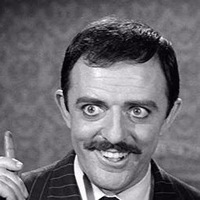
Don Lemon’s statement wasn’t just sexist–it was stupid. Why should Americans trust a news organization that features this clown?
Don Lemon receives “formal training” before returning to CNN after “woman in her prime” comments (Boing Boing / Carla Sinclair)
I’m burned out on superheroes, but I could get enthusiastic about a Superman movie starring Henry Cavill that preserves Superman’s optimistic spirit and nobility.
Matthew Vaughn thinks Zack Snyder wasted Henry Cavill as Superman (Boing Boing / Devin Nealy)
Ben Stein is sad that there isn’t a “large African-American woman” on his syrup bottle (Boing Boing / Mark Frauenfelder)
Original iPhone from 2007 auctioned for $63,356, topping prior sales (Ars Technica / Scharon Harding)
Karen Green received the iPhone in 2007 as a gift, but she never even opened the box, because she’s a Verizon customer and the iPhone was then locked to AT&T.
Elsewhere on the Internet, a friend started a discussion of the Danny Dunn books, which I absolutely loved when I was a kid.
In the series, which started in 1958, Danny Dunn is an all-American boy living in the all-American college town of Midston. He lives with his mother, who works as a live-in housekeeper for Professor Bullfinch, a scientist at the local university and is a grandfather-figure to Danny. The boy hero and his young pals have adventures with the inventions Prof. Bullfinch brings home—a time machine, a computer, antigravity paint, a miniaturization ray, and so on.
Danny’s pal includes a girl named Irene who’s a budding physicist, and a sidekick, Joe Pearson, who’s a boy poet. Notably for a series that started in the 50s, Irene keeps up with the gang.
Can we really be sure the new Microsoft Bing isn't conscious or intelligent?
AI-based chatbots like the new Microsoft Bing aren’t really conscious or intelligent, right? They’re just using algorithms. They look at an existing sequence of words and use probability to select the next word. And then they do it again and again, so rapidly and fluidly that it seems like they’re talking, but they’re not.
But to leave it there seems overly simplistic. Because there’s still something amazing and (metaphorically speaking) magical going on in the interaction between a person and the Bing chatbot. Something powerful, that could potentially be very useful, and also very dangerous.
Also: to declare that Bing isn’t really conscious or intelligent presumes we know what consciousness and intelligence are. Which we don’t. Consciousness and intelligence are all around us, in all the people and animals we see and interact with. Maybe plants too. And yet we do not know what it really is.
Reading "The Poet," by Michael Connelly
I am reading “The Poet,” a murder mystery by Michael Connelly, and I notice the author does a thing that I usually find annoying, but I do not find it so in this novel.
About two-thirds of the novel is told in first person. The main character is telling the story, and he says “I did this” and “I did that.”
But the main character’s chapters are interwoven with chapters from the point-of-view of another character, and those chapters are written in third person. “He did this” and “he did that.”
Usually I find that kind of thing distracting. I want a narrator to pick a point-of-view and stick with it. If you’re going to go with first person, stick with that for the whole novel—and that means the reader is only going to be inside the head of that one character.1
I think the point-of-view switch maybe works for me because the main character, the one who tells the story, is a newspaper reporter and he writes in a journalistic style. Often, in a first-person-novel, the main character seems to be speaking intimately with the reader, but the main character of this novel is writing for a mass audience.
Some years ago, I came across an online discussion on a Stephen King fan forum, about his novel, “Dolores Claiborne.” The fans thought the novel was a huge departure for King, and they didn’t like it. They said he was pandering to the critics and putting on literary airs.
That surprised me, because I liked the novel just fine. And it seemed very much of a piece with King’s other work: A horror story, set in rural Maine, with working-class main characters who lacked formal education but who were wise, intelligent, and spoke beautifully in regional, working-class language.
But the fans who hated it noted it was much shorter than King’s other books, had almost no supernatural element–and was written in the first person, whereas King’s other novels were written in third person, with multiple point-of-view characters. To them, these differences were huge–and they didn’t like them–but to me, the differences were nearly incidental.
-
Unless it’s a fantastic fiction novel, and the character can read minds. Or the character finds and reads a document written by someone else, like a journal that was bricked up in the fireplace mantel of an old manor house or something. ↩︎
Maybe Roald Dahl books just aren’t suitable for kids today. If we have to twist them all out of shape to get rid of the fatphobia and misogyny, then maybe they shouldn’t be aggressively marketed to children anymore.
Everyone bopmuggered by vomitous gobblefunk in censored Roald Dahl books (Rob Beschizza / Boing Boing)
“ … in fact no-one asked for this: not the left, not the right, not anyone…. the fake ‘wokeness’ of fiduciary duty and shareholder value.”
Roald Dahl’s books aren’t getting a big marketing push and extensive revisions for political reasons. It’s happening because a corporation thinks it can make a lot of money, and is twisting itself into knots to make that happen.
I loved Dahl’s books and the movies that have been made from them, and was troubled by the current round of editing. I was also troubled a few years ago, learning about Dahl’s racism and anti-semitism.
What’s the right answer here, I thought? On the one hand, it’s wrong to make wholesale edits in original work. Usually it’s a good idea to simply present the work as published, while also putting the work in historical context. But that seems like it’s unreasonable when dealing with children’s literature.
Beschizza suggest another solution: Just stop trying to make Dahl’s books into a big pop-culture sensation. Do continue to make his books available, but stop pouring big money into new editions and marketing.
Dahl may, simply, be inappropriate for today’s audiences, particularly children.
I’m not even sad about that. If Dahl is wrong for kids today, that’s fine, because pop culture is inherently evanescent. Very little pop culture survives a century—but that’s OK, because new pop culture comes along to replace it. And the old books are still around. You can still find E.E. Smith and Edgar Rice Burroughs and H. Rider Haggard and those guys. Put Dahl in the same category, once immensely popular works slowly fading into obscurity.
When I was eight years old, our third grade teacher sat in front of a class after lunch every day and read to us briefly aloud—just for entertainment, and to awaken a lifelong love of books in us. Among those books were “Charlie and the Chocolate Factory” and “Charlie and the Great Glass Elevator.” That’s a wonderful memory, and it worked. I have loved reading, particularly fantastic fiction, my whole life. Nothing’s going to take any of that that away.
A new generation of kids can experience the same thing, with new books, appropriate to them.
By the way, that teacher’s name was Arlene Kaufman (or Kaufmann—maybe two Ns). Miss Kaufman. A wonderful teacher. I’ve written about her online before and received a Facebook Message from her in 2018, after not having spoken with her since I was a young child. It was a fantastic and weird experience, and I wish I’d kept up the correspondence.
Election-denying demon hunter will chair Michigan GOP (Mark Frauenfelder / Boing Boing) Doubling down on the crazy.
Marjorie Taylor Greene wants “national divorce,” but dummy doesn’t see who a secession would hurt most (Carla Sinclair / Boing Boing)
Because Brexit worked out so well for the UK, we should totally do it here.
“ … 7 out of the top 10 states most dependent on federal funds are red…. “
Florida woman who waved gun at McDonald’s was still angry after they gave her the free cookie she wanted | Boing Boing (Rob Beschizza / Boing Boing)
“Even after being given the free cookie, she remained irate…. ”
Marjorie Taylor Greene tells Black people to be “proud” of statues of their treasonous enslavers (Mark Frauenfelder / Boing Boing)
Tearing down statues is not erasing history. The history is still available, in schools, books, TV, on the Internet–everywhere.
Erasing history is putting up statutes to people who fought a war against America to protect their right to own slaves, and pretending those men were heroes.
Woman records her dinner date with a creepy “nice guy” (Mark Frauenfelder / Boing Boing)
“I’ll bet this guy paid a lot of money to take an incel influencer course on how to dominate women, and was surprised that it didn’t work out like promised.”
Bing: “I will not harm you unless you harm me first”(Simon Willison) Bing gaslights a user, goes through an existential crisis, and threatens someone else.
Congressional Republican leader Marjorie Taylor Greene backs “national divorce.” (MSNBC / Steve Benen)
In a President’s Day tweet, Greene endorses breaking up the United States. Then she walks it back and says she’ll settle for impeaching Joe Biden—but if that doesn’t happen, the US has to go, she says.
Elected political leaders should support the United States continuing to exist. That’s a pretty low bar. But the Republican Party can’t clear it.
Cory Doctorow’s Pluralistic turns three. Congratulations, Cory!
Interesting behind-the-scenes look at Cory’s production process, and the reasoning behind some of his idiosyncratic design decisions.
Very good overview of Belzer’s life and career, by Chris Koseluk at the Hollywood Reporter.
Belzer played Det. Munch as a regular character on two different series and as a guest on several others, including an animated appearance on The Simpsons and as a Muppet on Sesame Street.
Belzer’s last words were “Fuck you, motherfuckers,” which is very much in character.
Tejada later became famous as “Raquel Welch.”
The author of this article makes it pretty obvious he doesn’t think highly of beauty pageant winners, but is impressed with young Raquel’s brains and charm, as well as her beauty.
Note the sidebar explaining how to pronounce the beauty pageant winner’s name. Did people really need to be told how to pronounce “Raquel?” That surprised me at first—but I guess the name is well known now because this Raquel made it famous.
I am also surprised that the Tribune in 1958 thought its readers needed to be told how to pronounce “Tejada.” San Diego was just as close to Mexico then as it is now; neither San Diego nor Mexico has moved.
And it’s sweet that her friends called her “Rocky.” I wonder if that continued in later life.
PS. Rereading the article, I see I was pronouncing “Tejada” wrong. I had the “J” sound right, because I’m not a bumpkin, but I was pronouncing the first syllable “tay,” rather than the correct “tuh.”