
Lawyers Guns Money: “It turns out the whole Taylor Swift-Travis Kelce romance is just another Democrat conspiracy to defraud White America of its birthright, which for those of you scoring at home is complete dominion over the United States.”
NYTimes: MAGA nincompoops are losing their shit over Taylor Swift dating Travis Kelce—Vivek Ramaswamy says its a conspiracy and a Fox News commentator says its a four-year-old Pentagon/NATO psy-op.
Reading about Yusef Salaam’s traffic stop in both the New York Times and NY Post I can’t see how Salaam (or the police officer) did anything substantially wrong or how Salaam disparaged police. More MAGA bullshit.
Tuesdays, the Savage Love podcast drops and I always enjoy that. But I’m going to listen to the AppStories podcast first today because this week’s topics look interesting.
I guess that means the AppStories podcast is better than sex.
I’m intrigued by Project Tapestry, an app in development from Iconfactory that creates a single feed for social networks, blogs, weather alerts, RSS feeds and more. But it sounds like a feed reader, similar to Newsblur (my current favorite), Feedly, Feedbin, Inoreader, etc. Am I missing something?
Forbes: Google’s AI will read all your private messages—and Apple might do the same.
This is a flagrant violation of privacy.
Via Violet Blue’s Cybersecurity Roundup—thanks!
The National Security Agency (NSA) has admitted to buying records from data brokers detailing which websites and apps Americans use, US Senator Ron Wyden (D-Ore.) revealed….
… the senator is calling on all intelligence agencies to “stop buying personal data from Americans that has been obtained illegally by data brokers.”
”The US government should not be funding and legitimizing a shady industry whose flagrant violations of Americans' privacy are not just unethical but illegal”….
Via Violet Blue’s Cybersecurity Roundup–thanks!.
An 18-year-old British man was acquitted of charges of public disorder after he joked with friends in a private Snapchat conversation about blowing up a flight he was a passenger on. (Via Violet Blue’s Cybersecurity Roundup—thanks!).
Today’s ephemera: A sufficiently large trebuchet




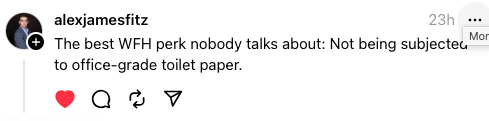
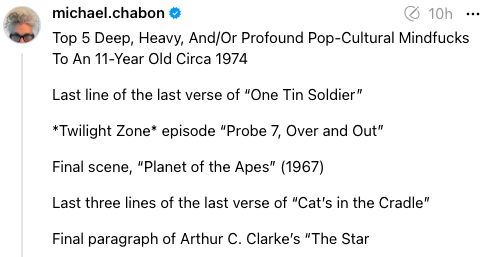
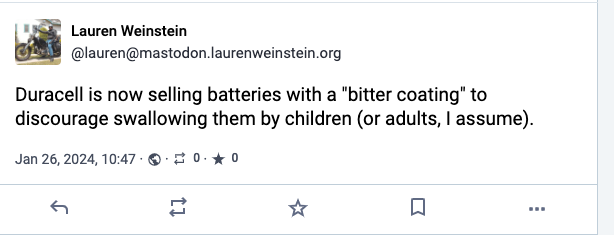
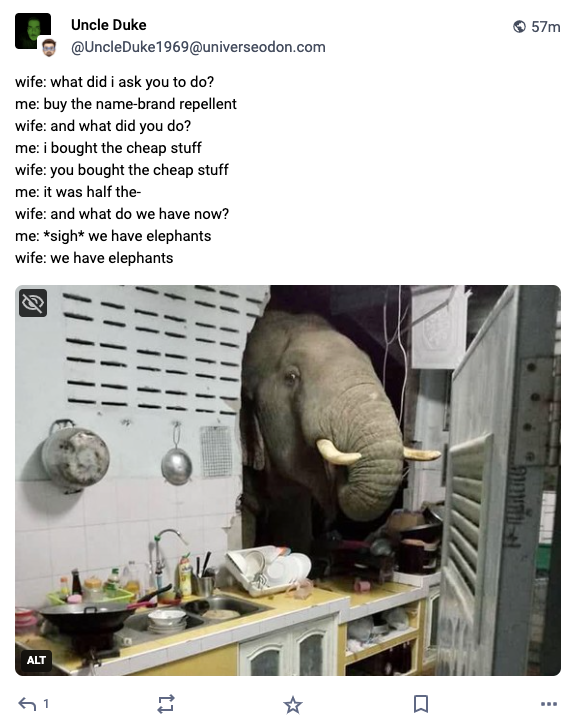
There goes my super-secret salad recipe. It’s been a big hit at PTA potlucks.



Currently reading: The Life of the World to Come by Kage Baker 📚

Finished reading: A Closed and Common Orbit by Becky Chambers 📚
Coronado residents are protesting the Hotel Del agreeing to host a service by the Awaken Church, a toxic MAGA organization whose leaders espouse vile LGBTQ-phobic beliefs. The head pastor “shares violent messaging and images, argues for the ‘public hanging’ and ‘torture’ of people he disagrees with and encourages the violent overthrow of the government.”
What’s behind the tech industry’s mass layoffs in 2024?.
There is a herding effect in tech…. The layoffs seem to be helping their stock prices, so these companies see no reason to stop.
Layoffs “are contagious…. when one major tech company downsizes staff, the board of a competing company may start to question why their executives are not doing the same.”
The San Diego Union-Tribune looks at my favorite hiking trail
I’ve walked the Lake Murray trail several times a week for more than 10 years; I know it so well that I can identify exactly where the photographer was standing for most of the photos in this article.
The entire trail is 6.4 miles round-trip; I do half that on my daily walk with the dog and usually start at the house.
Israeli officials presented details to back up their claims that UN relief workers helped Hamas in the October raid. “One is accused of kidnapping a woman. Another is said to have handed out ammunition. A third was described as taking part in the massacre at a kibbutz where 97 people died.”
German-born photographer Evelyn Hofer captured beautiful photos of Dublin in 1965-66. “Hofer took her time composing each shot, whether it captured a pair of housekeepers in brief repose or James Joyce’s death mask.”
I had a Zoom meeting yesterday and I put it on my calendar but instead of “Zoom” I mistakenly wrote “Zoomies” and so instead of my meeting I went out in the backyard and ran around in circles as hard as I could for a while and then I collapsed and had a nap.




Only 90s Web Developers Remember This. The halfway point of this essay is where my Web development skills end.
How Cory Doctorow uses browser tabs for productivity superpowers
Cory defends lifehacking, which “is in pretty bad odor these days, and with good reason: a once-useful catch-all for describing how to make things easier has become a pit of productivity porn, grifter hustling, and anodyne advice wreathed in superlatives and transformed into SEO-compliant listicles.” But at its core, lifehacking is just a collection of little tricks that help people be more productive.
He links to his notes from a 2004 talk by Danny O’Brien: “Life Hacks: Tech Secrets of Overprolific Alpha Geeks”.
O’Brien’s inspiration was his social circle, in which people he knew to be no smarter or better or motivated than anyone else in that group were somehow able to do much more than their peers, in some specific domain. O’Brien delved deeply into these peoples' lives and discovered that each of them had merely (“merely!") gotten very good at using one or two tools to automate things that would otherwise take up a lot of their time.
These “hacks” freed up their practitioners to focus on things that mattered more to them.
… everyone who created a little hack was faintly embarrassed by it, and assumed that others who learned about their tricks would find them trivial or foolish. O’Brien changed the world by showing that other people were, in fact, delighted and excited to learn about their peers' cool little tricks.
(Unfortunately, this eventually opened the floodgates of overheated posts about some miraculous hack that turned out to indeed be silly and trivial or even actively bad, but that wasn’t O’Brien’s fault!)
Cory notes that he is a pretty productive fellow himself, having written nine books during lockdown. And he shares a couple of his little tricks.
One of them is having “a group of daily tabs that I open in a new browser every morning. The meat of this tab group is websites I want to check in with every day, either because they don’t have RSS feeds, or because I want to make sure I never miss an update.”
These include news and opinion websites, Wikipedia pages whose edits he is watching, and also personal finance and ecommerce sites.
I do something similar: I have three folders of tabs: One I open multiple times daily, another that I also open multiple times daily, but less often than the first group, and a third that I open 1x/day. I call them, imaginatively enough, “First,” “Second” and “Daily.” The first group is social media replies, the second group is social media streams, and the third group has more social streams, Discord channels and one or two blogs that have lousy or nonexistent RSS feeds.
Tabs, like lifehacks, are also in bad odor. Everyone stresses about how many tabs they have open…. But this is a very different way to think about tabs. Rather than opening a window full of tabs that need your detailed, once-off attention later, this method is about using groups of tabs so that you can pay cursory, frequent attention to them.
I find RSS, newsletters and daily tab groups do the same job, enable me to check on a couple of hundred websites daily in very little time. I currently use the NewsBlur RSS reader, which is also a great place to read newsletters. (If you don’t like NewsBlur, my friend Barbara Krasnoff writes up five good RSS readers.)
Also:
My little tab habit is so incredibly useful, such a powerful way to seize back time and power from powerful actors who impose burdens on me, that I sometimes forget how, for other people, tabs are a symptom of a life that’s spiraling out of control. For me, a couple hundred tabs are a symbol of a couple hundred tasks that I’m totally on top of, a symbol of control wrestled back from others who are hostile to my interests.
Cory talks about how tabs are an example of “generative” technology—innovations that users implement in ways that were unanticipated by people who developed technology.
It occurs to me that a reason I love the Obsidian documents app is that it’s an example of “generative” technology. I use Obsidian in weird ways that don’t seem to be the designers’ intent, but it works well for me—and I think that actually is part of the designers’ intent.