
An in-depth explainer why the New York Times might win its copyright lawsuit against OpenAI, which the AI community says would be catastrophic. arstechnica.com
Japanese startup Astroscale’s mission is cleaning up space junk. arstechnica.com
We watched the first episode of “Resident Alien,” about an extraterrestrial who assumes the identity of a doctor in a Colorado small town where people are colorful. “Northern Exposure” meets “Starman.” The show stars Alan Tudyk, who played Wash in “Firefly.” Pretty good. I’ll give it another try.
Before the IBM PC, There Was the TRS-80
Radio Shack, known for its DIY kits and gear, unveiled this low-cost computer in 1977 in a bid to capture the fledgling PC market.
I had forgotten that the consumer PC revolution started in the mid-late 1970s, even though I was a teen-ager then and aware of what was going on. I think of it as a mid-80s phenomenon.
Trust Between Southeastern San Diego Flood Survivors and Local Government Is Dead
Flooded residents of the Southcrest, Shelltown and Mountain View neighborhoods of San Diego say they’ve been abandoned by the city and county and some say politicians are trying to drive them out to inflate real estate prices.
Will Huntsberry at the Voice of San Diego:
The flood waters have receded, but in these southeastern San Diego neighborhoods a crisis of trust is now ripping through the streets. From block to block the narrative is the same: City officials knew for years the flood canals were clogged and did nothing to clean them. After the floods, city leaders didn’t jump into action to provide relief; it was neighbors and homegrown nonprofits.
The residents of these historically Black and Latino neighborhoods can draw but two conclusions. At best, city leaders don’t care if they are forced from their homes. At worst, city leaders want them gone.
…
In other words, city leaders purposefully allowed Shelltown, Southcrest and Mountain View to flood, so that other people could take the land.
City officials, of course, have offered many explanations for why they never cleaned Chollas Creek. The amount of money for stormwater improvement is dangerously low. Certain environmental regulations were hard to get around. They have also said the amount of rain was so severe that cleaning the canals would not have stopped the floods. But none of this has resonated with the flood survivors. Would so many calls for a channel to be cleaned have gone unanswered in La Jolla they wonder?
Now, they are all forced to watch as the fabric of their community is torn apart.
Jessica Calix adored her neighbors in Southcrest. She rented a two-bedroom for $1,650 per month — unheard of in today’s rental market. Now, she’s stuck in a motel, searching for a new place. She can barely find a studio apartment in the same price range.
That’s bad for her and other renters, Calix said. But it’s good for landlords.
“Landlords will clean their places up and rent them for an extra thousand dollars or more now,” Calix said.
Roughly 70 percent of people in Shelltown, Southcrest and Mountain View are renters, according to US Census data.
And it’s not just renters being pushed out, according to the rumors going around. Stories of cheap cash offers for waterlogged houses are also making the rounds.
Rain and possible flooding is forecast to start again in a few hours and continue two days.
EFF: Don’t Fall for the Latest Changes to the Dangerous Kids Online Safety Act. KOSA supporters claim it protects kids, but it actually endangers them and unconstitutionally restricts free speech. One of the co-sponsors of the bill specifically says she wants to use it to suppress trans speech.



The season finale of “All Creatures Great and Small” was satisfactory. Drunk Carmody is my role model.
Ezra Klein: Democrats Have a Better Option Than Biden. Biden is a great President, but he’s running a lousy re-election campaign. Polling shows him losing to Trump. The solution, says Klein, is for Biden’s closest advisors—people like Barack Obama and Chuck Schumer—to convince Biden to stand aside and not seek re-election, and then to choose a new candidate at the convention.
The New York Times explains the controversy around the 2023 Hugo Awards, hosted by China
The Hugo Awards, a major literary prize for science fiction, have been engulfed in controversy over revelations that some writers may have been excluded based on their perceived criticism of China or the Chinese government.
Suspicions in the science fiction community have been building for weeks that something was amiss with last year’s awards, which rotate to a different city each year, and in 2023 were hosted in Chengdu, China. Now, newly released emails show that the awards were likely manipulated because of political concerns.
Also:
“The Hugo Awards tried so hard to appease the Chinese government they circled back to being racist by preemptively disqualifying Chinese diaspora,” Xiran Jay Zhao wrote on X.
The Cluetrain Manifesto is turning 25.
The Marine Corps credited Mawhinney with 103 kills as well as 216 ‘probable’ kills that could not be confirmed because of the dangerous conditions in which the shootings happened…. The Oregon native recorded all of the kills before he turned 20….. Serving as a sniper “was the ultimate hunting trip: a man hunting another man who was hunting me,” Mawhinney told the Los Angeles Times in 2000. “Don’t talk to me about hunting lions or elephants; they don’t fight back with rifles and scopes. I just loved it.”
Today’s memes: This is love
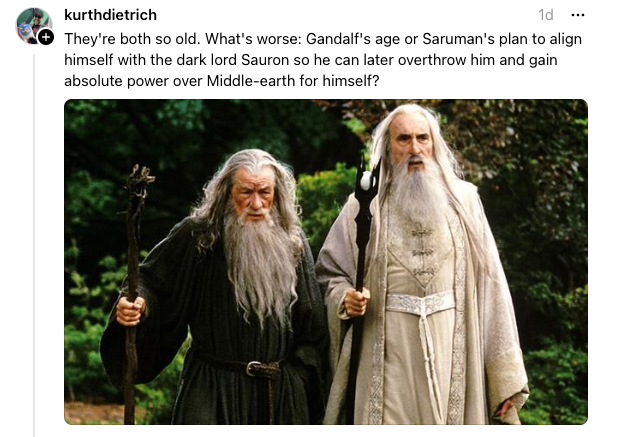

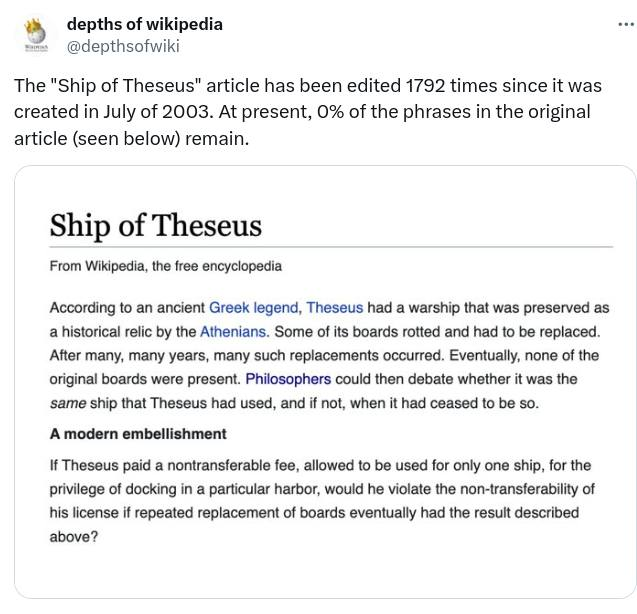

Superman II (1980) featured some ground breaking special effects, in particular the battle between Superman and the supervillains General Zod, Ursa and Non and here is special effects designer Derek Meddings (1931-1995) on the model “battle” set of Superman II. For his work on Superman (1978), he was awarded a shared Special Achievement Award for special effects by the Academy of Motion Picture Arts and Sciences, and shared the Michael Balcon Award of the British Academy of Film and Television Arts (BAFTA). He was also nominated for the 1980 Academy Award for Best Visual Effects for his work on Moonraker (1979), for the 1990 BAFTA Award for Best Special Visual Effects for Batman (1989), and posthumously for a 1996 BAFTA Award for Best Achievement (in special effects) for GoldenEye (1995). via
Facebook just sent me notices that it removed two of my posts for violating its rules. It won’t show me what those posts are so I don’t know how I violated the rules, therefore I can’t modify my behavior to be more in line with Facebook terms of service.
RSSParrot turns your Mastodon timeline into an RSS feed reader.
If you’ve been laid off – and especially if you’ve been laid off for the first time – you will blame yourself for being laid off. This post is just for you, and it can be summed up as this: you’re probably facing the consequences of someone else’s mistakes.
Upper management makes bad decisions, and employees face the consequences:
The decision-makers at companies making these layoffs sound like Lord Farquaad from Shrek: “Some of you may die, but that’s a sacrifice I’m willing to make.”
Cory Doctorow @pluralistic@mamot.fr: How America’s oligarchs lull us with the be-your-own-boss fairy tale. The gig economy, DEI and ESG are the latest iterations of a 70-year-old PR campaign to convince Americans that Big Business is their friend.
Bose introduced pricy open-air earbuds that sit on your ears, rather than in them. Bose is touting the devices as being comfortable enough to wear all day.
I already find my AirPods to be comfortable enough to wear all day. But I don’t because it would be weird, battery life isn’t up to all-day use and I can’t think of a reason why I would want to do that.
After much practice, I am now expert at photographing my own left ear. I do not expect this skill to be useful.
Antisemitic callers overwhelmed a La Mesa City Council meeting with hate speech. timesofsandiego.com. I am a Jewish person who has lived more than 25 years in La Mesa, a suburb of San Diego, California. This is terrorism.
UPDATE: I edited this post to remove criticism of the City Council. I have no reason to believe they behaved inappropriately.