Posts in "Journal"

Shakshuka is better than winning the Darwin Award

I had a meeting at 11 am at a local coffee shop. It’s been raining hard nonstop since Monday morning. This is not unusual back east, but it is unusual here, and because the drainage infrastructure isn’t built for it, it’s a cause for concern. We’ve had a lot of flooding. Not in my neighborhood—we’re fine—but elsewhere in San Diego, during another round of storms last week, cars were swept away and people had to be rescued.

I put on my rain jacket and hat and drove to the coffee shop. I got there about 20 minutes early. Every seat was full but that’s fine—I’m comfortable standing—so I stood there and drank my coffee.

A man wearing an Apple Vision Pro walked by me to approach the counter. When he walked by me the other way, I stopped him and I said, with no preamble or introduction, “Do you like it?” He knew what I was talking about, of course. He said he did like it. He said he edits video and he had two screens open and also his email. I said, “Now? While we’re talking? While you were at the counter?” He said yes. He was wearing the Vision Pro the whole time.

My meeting arrived a little early. A little more than half-hour in, every phone in the still-crowded coffee shop went off. We all looked at our phones. Tornado alert. Take shelter in a basement or somewhere away from windows. I happened to have gotten a table very far from the window, so I figured we were good.

I messaged Julie to check on her. She said she was going to get the dog and sit on the floor in the back hall, and try to get the cats too.

After a few minutes of no tornado, I thought about driving home. Could I beat the tornado? That seemed like maybe a bad idea, but on the other hand, I’m on a deadline today.

By now, it was after noon, and I decided to check and see what the place served for lunch. They had shakshuka. I love shakshuka. I thought about the options: Drive home during a tornado warning and not have shakshuka and maybe get killed and win a Darwin Award? Or stay in the coffee shop, have shakshuka, not get killed and not win a Darwin award? I went for the shaksuka option.

There was no tornado. It stopped raining. The shakshuka was delicious. The meeting was excellent. I left for home and arrived at about 1:15 pm. The sun was out, even though the forecast called for a solid wall of rain Monday through Thursday.

And that’s pretty much my day so far.

I went around and around the house looking for my phone, searching the usual places again and again, and finally got down on my hands and knees with a flashlight next to the bed and discovered the black phone had fallen off the nightstand and into a black shoe.

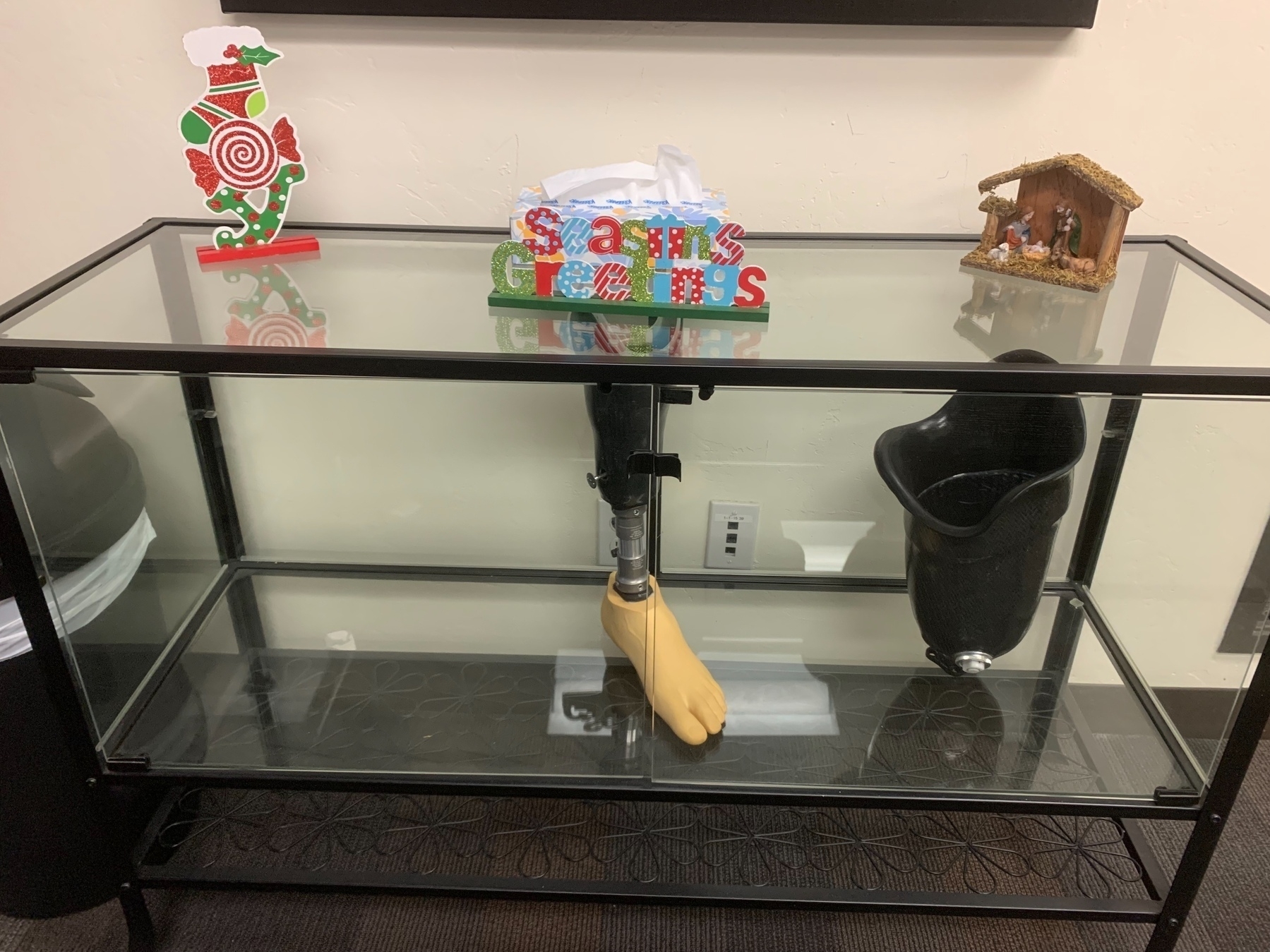
We saw this festive holiday display of leg prostheses. Please enjoy it.

A bit of family history, from my father’s service in Word War II

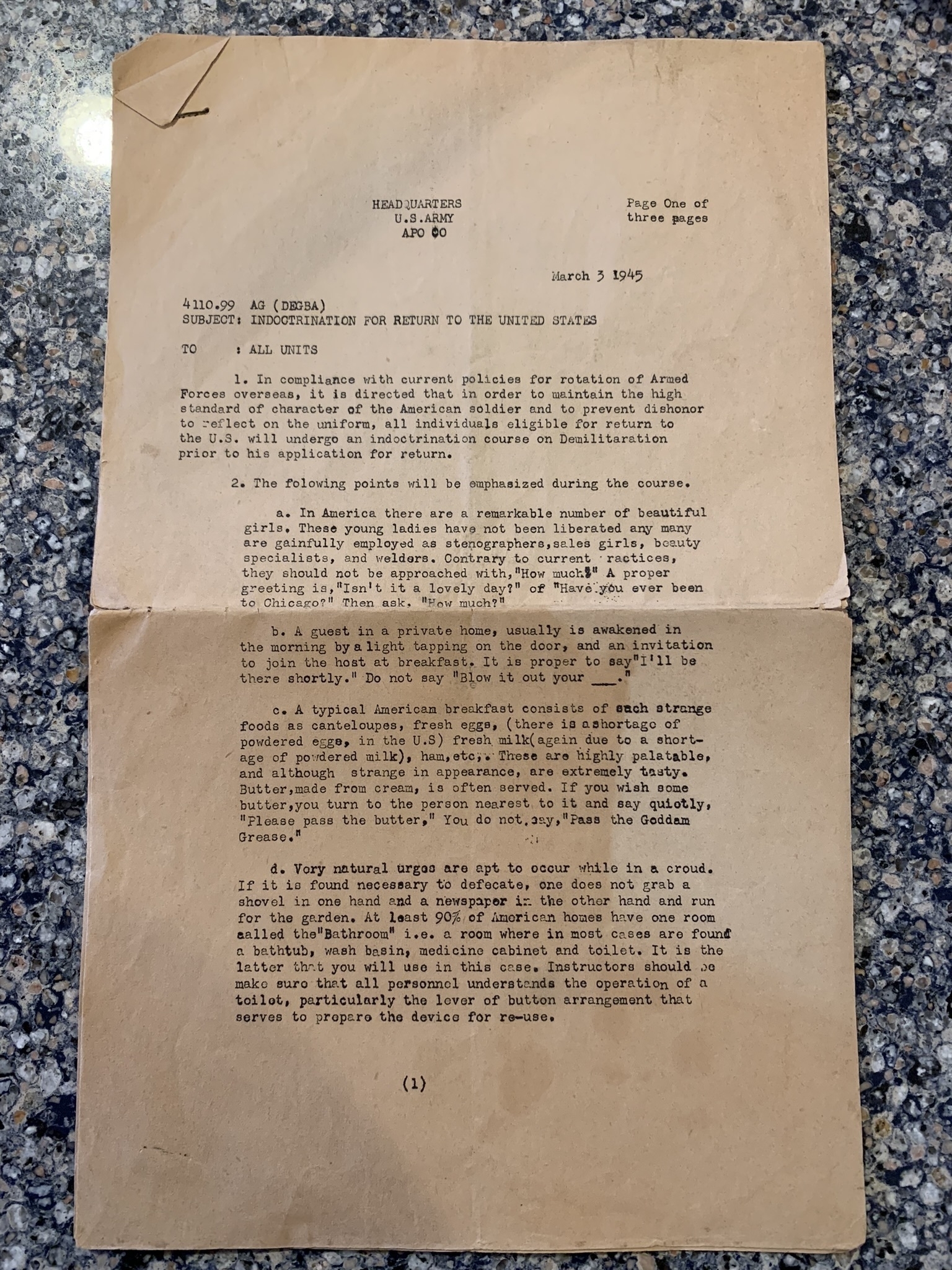
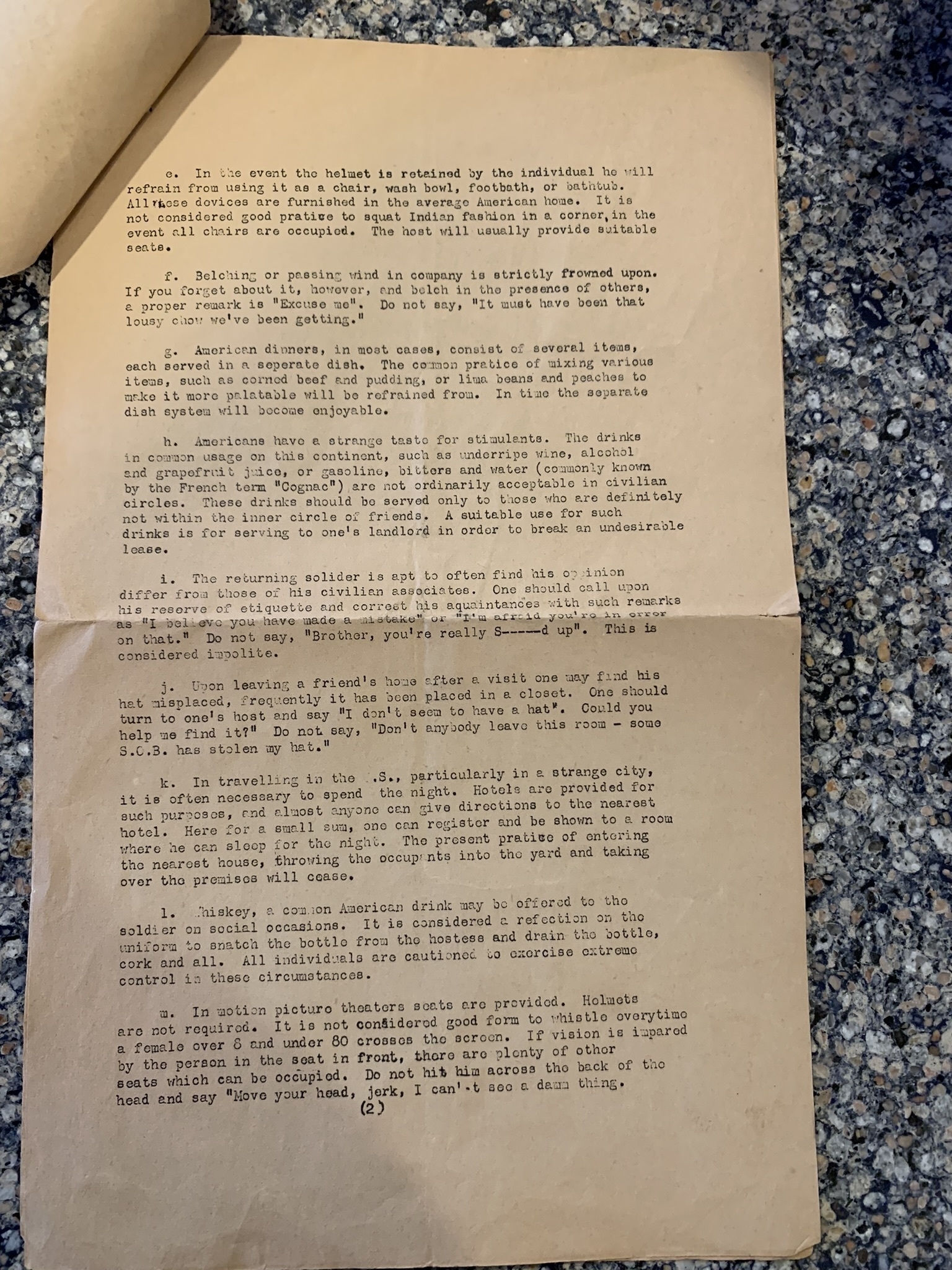
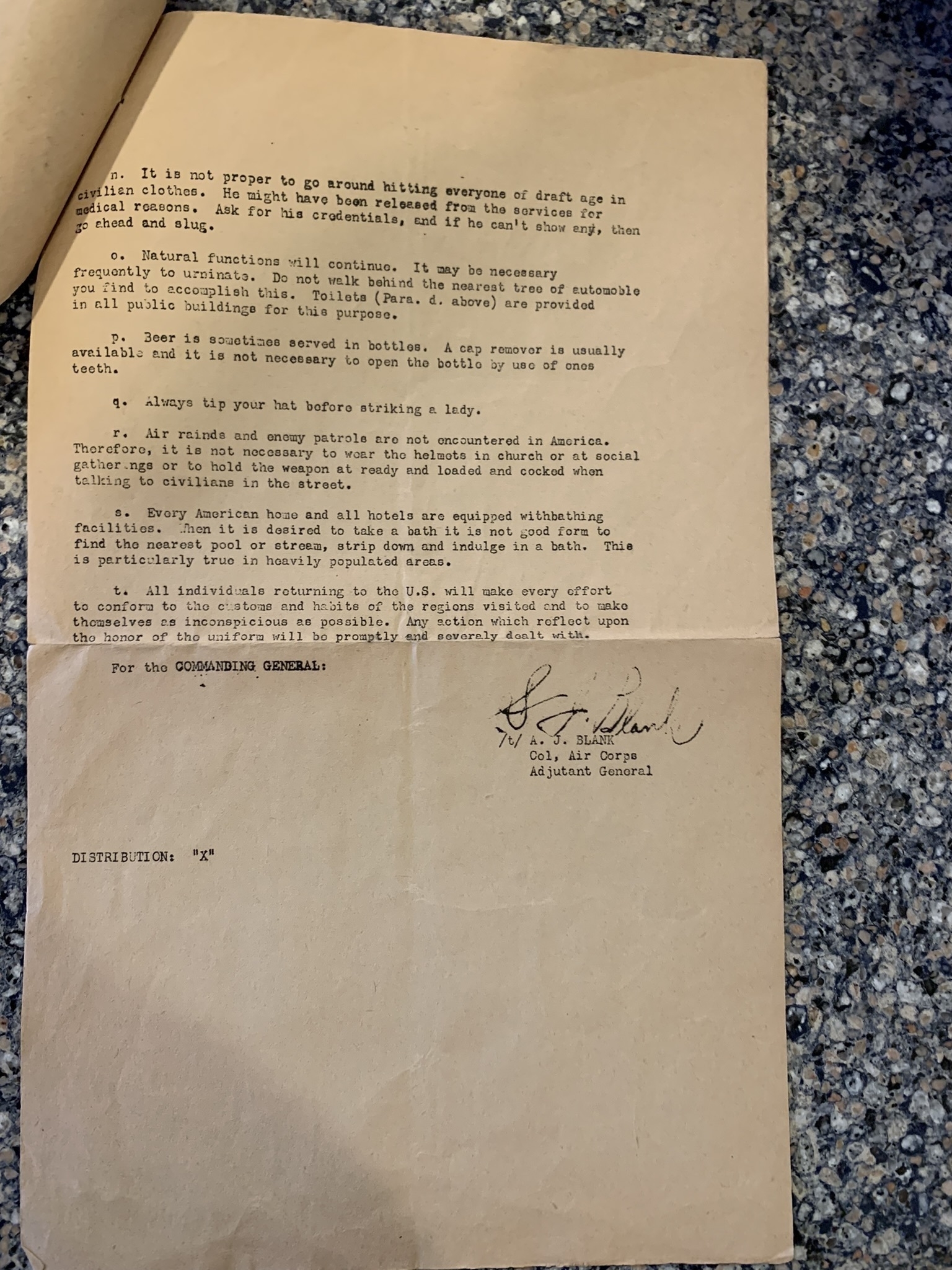
My father received these humorous fake orders when he was discharged from the army in 1945, the end of the war.

I found this document while doing some decluttering in my home office yesterday. The paper is brown with age and fragile to the touch. It’s apparently typed and mimeographed.

The document is written in the style of a military memo, instructing the men how to behave when they get back home to civilian life.

In America there are a remarkable number of beautiful girls. These young ladies have not been liberated and many are gainfully employed as stenographers, sales girls, beauty specialists, and welders. Contrary to current practices, they should not be approached with, “How much?” A proper greeting is, “Isn’t it a lovely day!” or “Have you ever been to Chicago?” Then ask, “How much?”

My father served in Burma, which is now Myanmar. I think he also did some time in Taiwan. When he was discharged, he was 21 years old. I think he served several years. A kid from Brooklyn. My father’s native habitat was the New York suburbs; I cannot imagine him in tropical Asia.

I found this document when I was a teenager in the 1970s, investigating the garage of our house on Long Island. I found it again while going through my Dad‘s papers after he passed in 2004. After that, the document disappeared into the clutter of my home office for nearly 20 years until I was decluttering this week, and the papers turned up again.

African safari journal: Homeward bound

June 2019 Our final Africa safari stop was Little Kulala Desert Lodge, in Sossusvlei, the Namib-Naukluft Park, Namibia. We took another small charter flight, from Hoanib Valley Camp – or, rather the nearest airstrip from that camp, which was about two hours’s drive away from the camp itself. Sossusvlei Geluk Airstrip is the usual empty airstrip, just a cleared length of land with one or two sheds. As at our other camps, one of the staff picked us up in a Toyota truck converted for passengers, enclosed but not air conditioned. The weather was another scorcher of a day with bright sunlight, even though it is the African winter. We were accompanied by the pilot of the plane, Graham, who was staying at the lodge overnight. About 15 minutes in, Graham conversed with the driver of the truck, Alfred, in Afrikaans, and then Alfred turned the truck around. Graham confessed that he was supposed to start a beacon on the plane to let his company know he’d arrived safely, and he’d forgotten to do that. When we returned to the airfield, Graham did that thing and then we turned the truck around back toward the camp.

I have to confess, we were road-weary at that point and ready to come home, but we still had four more nights in Africa ahead of us plus 28 hours on planes and in airports. And now as I write this a week after our return, I miss being in Africa.

There were only two things you could do in Sossusvlei that appealed to us: Seeing and climbing the majestic dunes, and visiting the Seasrim Canyon. That’s meant a two-night stay would have been ideal; we stayed for three and so we had some time on our hands. And because of the heat, Kulala Desert Lodge was not the ideal place to sit around and rest. There are other things to do in the area, but they did not appeal to us: Ride e-bikes and fat bikes, or go on a wine tasting. You can also take a balloon ride, but that would have cost $1,000, which seemed like a lot for a short experience. I’ve ridden on hot air balloons twice, once with Julie, it’s wonderful but we weren’t interested this time around.

Aside: I wrote all my other journal entries in Africa, with unreliable or no Internet access. Now I’m home with our lovely, home WiFi. And I can just look things up if I don’t know what they are. The name of the lodge we stayed at? The name of the canyon? Pow! Type in a few characters in a browser and there’s your answer. [Update from 2020: I wrote this journal entry in July 2019, a few weeks after returning home, based on notes on the trip.]

The lodge is laid out similarly to the other places we stayed, with a main building in the center, done up like a giant hut, containing the dining room, bar, outdoor seating, and offices and reception desk. The entrance is in front of that building. Spread out on either side were 23 cabins for guests, which are actually big, furnished canvas tents on platforms, as with Xakanaxa and other places we stayed. The lodge calls the cabins “kulalas,” from an African word for sleep. Because of the number of cabins, service was more hotel-like and impersonal; we enjoyed the family feeling at the smaller lodges we stayed at, such as Xakanaxa and Hoanib Valley, and liked Kulala Lodge less.

The dining room has big plate glass windows overlooking the flat desert plain, which seems to stretch off for miles to the distant mountains. We’d been to several African deserts by then, as well as the Anza-Borrego Desert at home, and each one seemed more austere and barren than the last. The shrubs at Sossusvlei are sparse and many tens of yards apart. There are few other animals there, just some birds and lonely impala and kudu.

The big draw at Sossusvlei, though, are the dunes. They are just piles of loose sand, hundreds of feet high and miles long, marching across the desert. One of the highlights of the visit is climbing one of the biggest dunes, called “Big Daddy.” 130 meters high. It’s strenuous, like walking on the beach but also climbing. The sand fights you on every step. And you’re standing on a relatively narrow path, with a steep slope on either side. The path is wide enough that I was only worried a little bit about falling. I was worried a little more about just getting down. I’d been assured by both tourists and guides that getting down is easy and fun, but I was skeptical; I have a lousy sense of balance and anything involving anything like climbing is tricky for me.

Climbing up the dune you have a long string of hikers both in front of and behind you. It isn’t crowded, but if you’re like me and you move slowly, you’ll be passed a couple of times. Like I said, it’s not crowded, but I got to thinking about the famous photos of climbers lined up to ascend to the summit of Mount Everest, like people waiting to get on a bus.

Despite the crowds, tourism isn’t a problem for the dunes, because every night the wind blows and cleans up the footsteps and repairs the damage. The dunes are like new every morning. That’s the theory at least.

I got about two thirds of the way up the dune and decided I had gone far enough. I wasn’t tired, but I’d spent enough time on the climb and didn’t have anything to prove. Also, I didn’t want to keep the other people on our bus waiting. So I turned to my right and went down the steep slope.

And it really was fun going down. I fell twice, but backwards, on my butt, and the sand is so soft it didn’t hurt a bit and I just popped back up. Both my feet were sunk in sand halfway up to my knees, so walking was more like wading and slow going. After I got about two thirds of the way down, I found a rhythm and the rest of the way down was like gliding slowly. Delightful!

We don’t intend to return to Sossusvlei – we feel like we’ve seen and done everything we want to there – but if we somehow do find our way back I want to do that climb again, and this time go all the way up to the summit and do the walk down properly.

In addition to Big Daddy, the attraction next to the dune is Deadvlei, a white clay pan that’s so dry that nothing lives there. Some trees are still standing, 800 years after they died. We were instructed not to touch the trees, lest they shattered.

After lunch, we decided to skip the afternoon activities, and just sat around the cabin in the heat.

The next morning, we were up early, and off to the Seasrim Canyon, which is about 100 feet deep and the third biggest canyon in the world.

We had the guide to ourselves that morning – and the entire canyon, too. Our guide said most people do the dunes in the morning and the canyon in the afternoon, when it can be excuse-me-pardon-me crowded. But we did not see another soul on the climb down and nearly the whole climb up, with just a lot of magnificent geology to ourselves. By that time we were overwhelmed by magnificent nature and a little burned out on it, but we still had enough awe left in our souls to be stirred, at least a little bit.

In the afternoon I began to get cabin fever, and decided to go for a walk along the dry riverbed that the lodge is built alongside of. It was perfectly safe, and a lodge-approved activity. I walk for exercise in a park at home, and this was similar, only dryer, and hotter, and instead of being accompanied by our dog, I had a fly following me much of the way and trying to land on my face. Festus, our guide previously, said flies there don’t bite; they’re trying to drink water from our faces. That must have been one thirsty fly. Along the route, I realize I did not have any solo selfies from the trip, which is like a violation of international law, so I took a couple. The fly photobombed one of them, landing on my face. A flyless African selfie from that afternoon is now my default online profile pic.

The next morning, we began the long journey home, which took two or three days. The nine-hour time difference and 28+ hour flight time from Johannesburg to San Diego make it confusing as to how much time has actually elapsed. The first step was back to the airfield, where we waited a half-hour in the truck for the “ground pilot” – the airfield’s one employee - to show up and open the gate. We didn’t mind; by then we were used to how things are done in Africa. Prior to our trip, I’d talked to a colleague who’d lived six months in South Africa; she said be prepared for things that should be easy to be difficult, and things you’d expect to be difficult to be easy. That stuck with me in incidents such as the wait for the ground pilot to show up. The plane wasn’t going anywhere; we were the only passengers.

We flew a bit more than an hour to the Windhoek Airport, and were met at the gate by our old pal Antone, who had driven us from Windhoek to Okonjima a week or so earlier. He waited with us to check in, poor bastard – there was a very long line and he had somewhere else to be.

The flight to Johannesburg was a commercial flight, and getting on the plane was the end of our safari adventures, because one-hour commercial flight in Africa is not too different from one in the US or Europe.

We arrived in Johannesburg, breezed through customs, and checked into the City Lodge. We were scheduled to get up the next morning for an 8 am private, guided city tour, but neither of us were excited for that. When we’d had Internet access, I’d checked Yelp and TripAdvisor and Google for things to do in Johannesburg and didn’t come up with much of anything. The Apartheid Museum got rave reviews, but it sounded depressing to me. I wanted to see Soweto, which had been the only place Blacks were allowed to live during apartheid, but Julie wasn’t enthusiastic about that. So we put off the tour until 10:30 am so we could pack at leisure.

The driver picked us up in a town car with leather seats, a far cry from the open, battered trucks we’d been bouncing around in for weeks. He had an encyclopedic knowledge of South Africa, Johannesburg, and its history. The one other place we wanted to see, other than Soweto, was Maboneng, which travel guides billed as a bohemian shopping district.

The driver, whose name was Seabo, offered to take us to Soweto in the morning and then to a native African place for lunch. I said hell yeah, because I was always on the lookout for native foods – nearly all the foods we’d eaten on this trip were European, although nearly all of it was delicious – but Julie said no. I thought for a moment and realized that it was not a great idea to sample street food in an unknown cuisine a few hours prior to getting on a plane for a 28-hour flight. So I passed too. Instead, we went to Maboneng, and Seabo dropped us off for lunch and a bit of walking round.

Maboneng was disappointing. It was crowded and a little threatening, like much of the rest of Johannesburg we’d seen, with a few cheap-looking shops and stands set up selling crafts that looked no different than the kind of thing you’d find at the airport. There were also a few Ethiopian and other African restaurants and a coffee cafe, which would have been tempting to me on another day, but like I said I didn’t want to try any strange cuisines just before a long flight. So we ate at an Italian restaurant/sports bar that was actually very good, and friendly. When we got out the neighborhood looked friendlier too; I even spotted one man who looked local, dangling a big camera from his hand. People don’t dangle big cameras in a dangerous neighborhood. Not for long at least.

Seabo returned shortly after lunch and took us to Soweto.

Soweto, he explained, is home to 1.2 million people, which makes it a respectable city within the city. It has neighborhoods of great poverty – shantytowns and slums made of scrap metal – which, Seabo noted, are all that you see in photos and video of Soweto. There are also middle class homes, and even affluent residences. Even the affluent residences seemed cheek-by-jowl close to each other, and small to me, though Julie said she thought some of them were larger. They had high fences around them, suggesting a high crime rate. And you’d see poverty and affluence very close – a shed or just open air tables selling a hodgepodge of merchandise, just a few steps from a scavenged home. Hand-painted advertisements adorned walls, touting businesses; I noted a lot of building contractors. Businesses mingled with housing. If there were any zoning laws in Soweto, I didn’t see evidence of it.

I saw livestock grazing in empty lots, cattle and goats. In the middle of the city!

Seabo lived in Soweto; he seemed to like it.

Seabo offered to stop to let us out at Nelson Mandela’s and Desmond Tutu’s homes, he seemed disappointed when we didn’t get out. But that street was dense with panhandlers, buskers, and other street people, who seemed aggressive; not violent, but not inclined to take no for an answer. Julie and I were not in the mood to run that kind of gauntlet.

We arrived back at the hotel at 3:30 pm, said goodbye to Seabo – who really was a good guide; we were just bad tourists – and made our way to airline check-in.

All in all I was not impressed with Johannesburg. It seemed to me the kind of place you’d only ever go to if you for financial reasons. Maybe, like Seabo, you were a poor villager looking to make a living. Maybe you’re a millionaire looking to be a billionaire. Or maybe you’re just somebody in the middle.

And then we were on our way home. I barely slept on the 28+-hour flights, watched something like five movies, two seasons of The Good Place, then slept most of the next 24 hours when we arrived home. Several days later I drove a car for the first time in a month; I did not hit anyone or go off the road.

We talk a lot about going back. We went to Africa really on a whim; it felt like a fun adventure. And it was, and we’ve fallen in love with it. Maybe in three years, if we can afford it financially. I’d like to see gorillas and chimpanzees, visit the Olduvai Gorge where the first people on Earth lived millions of years ago, see Cape Town, spend a day each in Windhoek and Swakopmund, spend more time in Botswana, get Festus to guide us around. Africa is a big, beautiful continent with so much to do! 🌍📓
What is a “digital garden?”

I encountered the idea of a “digital garden” Friday and was instantly enthusiastic and spent some time this weekend nerding out about it. Here is the result – the beginning of my digital garden: mitchwagner.com.

A digital garden is a personal website curated by its author, with essays and information about the subject or subjects they’re excited about. Some are wide-ranging and complex and cover a variety of subjects, while others cover a single subject, such as neurology or books,

Here’s a directory of digital gardens. It’s a digital garden of digital gardens!

Digital gardens provide an alternative to chronological streams such as blogs and social media. Streams are great for finding out what’s happening and whats new now. But they’re lousy for organizing information. Also, streams are terrible for longevity. Once stuff gets pushed down off the top of the stream, it disappears. Digital gardens are places where you can organize information and keeping information available over the long term.

Digital gardens can be very simple, just an index page or a Google Doc. Or you can use sophisticated software to create complex, Wikipedia-like documents.

After a while thinking about this idea, I realized that we’re talking here about the old, 90s “personal website.” People back then would create websites devoted to their favorite bands, or hobbies, or just their own lives and interests. Eventually these got swallowed up by Wikipedia, Google and the various social media silos.

Digital gardens are an extension of, and renaming of, personal websites. That doesn’t make the idea less powerful though.

Digital gardens are exciting to me, personally, because they solve a couple of problems that I’ve been noodling about for years. One problem is that I post a lot of stuff to my streams. Some days I post a dozen or two dozen items. Most are ephemeral – links to breaking news articles, some with comments, some without. Wisecracks. Memes. Old ads and photos from the mid-20th Century.

But some of what I post seems like it should be more long-lasting, whether it’s a book review or the journal of our 25th anniversary safari to Africa last year.

A digital garden solves that problem. I can just put up an index page of links to long-lived and notable content, and let that — rather than the blog or my biography — be my home page. I’ll continue with the blog and keep the bio. But the index page will be the main entrance to my site.

Again, this is not a new idea. Gina Trapani has been doing that a few years, and I don’t think she would say her idea is particularly original to her. But it’s still a great idea — and it’s new to me.

The second problem that digital gardens solve for me is that I’ve been noodling about ideas for projects for, well, several years now. Interviews with people I find interesting, software reviews and how-tos. Occasionally I have even acted on these ideas. But I don’t do it often because I don’t have a permanent home for them.

Resources

My digital garden: mitchwagner.com.

Here’s the article that got me excited, and introduced the idea of “digital gardening” to me: Digital gardens let you cultivate your own little bit of the internet

How the blog broke the web – Amy Hoy provides a brief history of blogs and social media, and discusses why they’re not great ways to organize information.

Hoy says there were only 23 blogs in 1999? Amazing. By late 2001 there seemed like a million of them.

Maggie Appleton: A Brief History & Ethos of the Digital Garden – Apparently the term and idea has been around in various forms for more than 20 years. Not surprising. The internet is a tangled web. Streams and search engines are two great ways to find stuff, but stuff can still be hard to find. That’s not a new problem.

Maggie Appleton’s directory of digital gardeners and digital gardening tools

Maggie’s Digital Garden

Maggie again: A brief overview of digital gardens as a Twitter thread.

A list of artificial brain networked notebook apps – These include a couple of familiar names to me, such as Roam Research and Obsidian. They seem to be a mix of private note-taking apps, Internet publishing tools, and private apps that can also publish to the public web.

This is a take on “digital gardens” that borrows from the philosophy of “zettelkasten.” Put simply, a zettelkasten is a system of note-taking where you write down each idea separately — in its original vision decades ago, you wrote each idea on a slip of paper or index card, though now of course there are digital versions — and then link madly between related notes. Ideas can come from books, articles, thinking, observations, whatever. Zettelkasten advocates say they can come up with fresh insights simply by returning to their zettel and following the links. German sociologist Niklas Luhmann, who invented the idea, credited his zettelkasten as a collaborator on many papers and books.

You don’t have to use dedicated software for a digital garden. Mine is just an index page for my existing blog.

Second Brain – “A curated list of awesome “Public Zettelkastens 🗄️ / Second Brains 🧠 / Digital Gardens 🌱”

Digital Gardens – Another explainer with a couple of examples. The author says:

In basic terms, [a digital garden] is a different format for written content on the web. It’s about moving away from blog posts ordered by dates and categories, into more of an interlinked web of notes.

One of the main ingredients is bi-directional links between those notes, creating a network of notes, similar to Wikipedia.

I would not say that the notes have to be interlinked, Wikipedia-style. Though they can be.

gwern.net – A very nice example of a digital garden covering a broad range of subjects.

Article: My blog is a digital garden, not a blog by Joel Hooks.

Our Africa journal – Saying goodbye to a new friend

June 23, 2019 — Yesterday, we left the camp for our next stop. Festus drove us two hours over those rough desert roads to the same airstrip we’d flown in to. We arrived 40 minutes early so we had time to spend with our new friend. We sat in the same shelter where we’d had our first lunch together three days earlier, and talked.

Festus told us how he found his way when guiding people through through the bush. I thought maybe he’d memorized the features, the trees and rocks and hills and such, like Mark Twain memorized the Mississippi River. He said no, those things change, but the desert is surrounded by mountains and he looked for the relative position of the peaks to figure out where he is. I was reminded of how I found my way around by car when we lived in Boston; the Prudential and Hancock skyscrapers towered over the skyline and were visible miles around. I looked for those two towers and their positions relative to each other and that gave me a first approximation of my position and whether I was moving in the right direction.

The airstrip was just a cleared stretch of flat ground with a few sheds at one end of it, where we sat. The only other people were a young Himba man, wearing Western clothes, who worked as a sort of attendant, along with two of his buddies, keeping him company. I was reminded of a rural gas station in upstate New York that I visited for two minutes to get driving directions one night years ago when I got lost on the way to visit a friend. I thought at the time that I blew through that town in less the five minutes but those three friends had probably been at that gas station for years.

In addition to the three Himba men, the only other denizens of the airstrip were two emaciated, medium-sized dogs who walked slowly through. They didn’t belong to anyone; they were just passing. They came to the door of the restroom and watched with sad eyes while I did my business in there. I am usually leery of off-leash dogs but pair looked so sad I just wanted to give them a bath, take them home, feed them a nice supper of boiled chicken and rice, and then curl up on the couch and watch TV together. One of the Himba men attempted to chase the dogs off by throwing pebbles and shouting at them. The dogs looked like they had been ready to move on anyway. Three more dogs, equally skinny, forlorn and slow moving, came through a few minutes later.

We had a surprisingly moving goodbye with Festus, considering we’d only been together three days. Festus gave me a warm triple handclasp with both hands and looked me in the eye, a traditional greeting he’d taught us. I’m afraid I rushed it; Julie pointed out to me later that I’m just not an emotionally demonstrative person, other than with her. I’m working on that. I hope Festus will remember our conversations and my sincere respect and affection for him, and that he will forget my hurried goodbye.

And we got on the small plane to our next stop, which was actually two flights, one more than an hour to Swakopmund, a small city founded by Germans for mining and other industry, and then we switched planes while the first refueled, to go more than another hour to our current destination, Sossusvlei. Our planes on both legs were Cessna C210s, with two passenger seats for me and Julie, the only passengers, and a couple more seats temporarily removed for our luggage.

I’m getting to quite like small planes. The ride is more interesting, even if it is more likely to be scary sometimes. You chat with the pilot. They give the safety and orientation talk personally and always include the same joke: They show us the airsickness bag and tell us if we use it we should not return it; instead, keep it “as a souvenir” of the airline. For our our first leg, to Soussesvlei, I did the joke before the pilot did. He was chagrined; I’d stepped on his laugh line!

During our brief layover in Swakopmund, the airline parked us inside a small waiting room in a hangar. It was a bit of a transition after our time in the bush, a proper modern waiting room with a sign with the WiFi password. This was my first access to good WiFi in a week and I slurped up email and reviewed it on the plane. I had left an out-of-office message that said I would be out all June and NOT reading email, even when I get back, so anyone who needs anything should email my colleagues or message me again in early July. I am adhering to the spirit of that message; I only plan to read a few messages when I return. The only reason I’m even checking email is to see if anything cataclysmic or wonderful happens. So far there’s been neither, just work and my friends and family rolling on without me. Similarly, I glance at news headlines every few days and am surprised by how inconsequential it all is.

On the leg from Swakopmond to Soussevlei, we had a scenic flight, and the pilot pointed out landmarks from the air, including salt processing fields, two shipwrecks, one of which is now deep inland as the desert advances over the century since that disaster, and the dunes of Soussuslei.

Sossusvlei is a big, dry hot desert. Every time I say someplace in Africa is pretty dry and hot and desolate, we go someplace even more dry and hot and desolate. Geology is Sossusvlei’s big draw, including miles and miles of sand dunes, stretching up to hundreds of feed tall. Like our two previous destinations, Soussusvlei is blistering hot by day, even now, in African winter, though it gets cold at night. It can get up to 50 degrees C in summer.

🌍📓

The first movie I saw in a theater

A friend asked her Facebook friends what was the first movie that they remembered seeing in a theater.

I dug through the IMDB to find some of the earliest movies I remember seeing in theaters and enjoying. They include Doctor Doolittle, Chitty Chitty Bang Bang, the Love Bug and the Jungle Book. They came out in 1967-68.

Also at about that time I remember a movie with Sammy Davis Jr. — I probably had no idea who he was when I first saw the movie, but I recognized him later, in memory. For most of my life I remembered one or two scenes of that movie and how much I enjoyed it but I couldn’t remember the name of the movie or what it as about.

I remembered Sammy was in a castle and that the movie was a comedy. I remembered one scene where he was shouting out a window. Not a lot to go on, but enough for Google:

Salt and Pepper.” It’s from 1968 and also stars Peter Lawford.

The “Salt and Pepper” movie poster. It’s groovy.

After discovering the body of a murdered female agent in their trendy Soho, London nightclub, groovy owners Charles Salt and Christopher Pepper partake in a fumbling investigation and uncover an evil plot to overthrow the government. Can our cool, yet inept duo stop the bad guys in time?

Here’s the trailer on YouTube:

Sammy Davis Jr. plays Salt and Peter Lawford plays Pepper. Get it?

It’s not a children’s movie, but I expect my Mom wanted to see it and so she dragged my Dad and me and my brothers. I remember my parents hated it and my brothers were too young to get it, but I loved it. I thought Sammy and Peter Lawford were cool. Which they absolutely were, but the movie looks like a turkey.

📓📽

African safari journal – one year ago – we visit a tribal village

June 21, 2019 - Yesterday was busy even by the standards of this trip. Up at 6 and out at 6:30 to the main tent for breakfast and coffee. The coffee is not bad here; it’s not great, but drinkable black.

I chatted with Jordanna, an Asian woman with a posh English accent. I asked where she is from; she said London. If she had said Singapore, I would not have been surprised – Crazy Rich Asians. [Note from 2020: I had just seen the movie a few weeks earlier on the plane over. Only a year later and that pop culture reference seems hopelessly dated.]

=-=-=-

Later at breakfast yesterday we had a conversation with Ross and Agnes, a couple from Atlanta. We talked about the difficulties of bad WiFi – how bad WiFi is worse than no WiFi, because with no WiFi at least you know you have no WiFi, but with bad WiFi you’re endlessly pulling to refresh. [Note from 2020: The Oatmeal did a comic on just this very subject: <theoatmeal.com/comics/no…>]

I was so used to meeting non-Americans – Namibians and Botswanans in particular – that when they asked where we are from, I reflexively nearly said, “The United States. California. San Diego,” which is now my stock answer I told them that and they laughed and said that when telling non-Americans where they are from, they say, “Atlanta. It’s a big city in Georgia. Which is next to Florida.” People around the world have heard of Florida.

Festus, our outstanding guide, took us out for a game drive in the morning, and the highlight of that was finding lions feeding on a zebra. I found it fascinating, but neither thrilling nor disgusting. It was nature.

But the highlight of the day was a visit to a Himba tribal village, a family of about ten people living as their ancestors have probably done for tens of thousands of years. We drove about two hours through the hot desert, flat and khaki colored and featureless like much of it is here in Africa, with the occasional hardy plant. We went through canyons and saw zebras galloping at full speed, despite the heat. That’s how zebras move by default – always at a gallop, Festus told us. The male zebra brings up the rear of his harem. We saw ostriches too.

The village comprises two large rectangular kraals, totaling an acre I guess, made of the same rough vertical wood branches that are standard for those sorts of structures. One is for goats – we saw a few wandering around – and the other is for cattle. That’s mainly what the Himba live on, their diet consists of a great deal of protein, Festus told us later.

There were ten people in the tribe, a man, his wives, a few toddlers and very young children, and a younger man who looked to be about 15 or 16. They were nearly naked, the women with their breasts uncovered. The primary man, who we interacted with mainly, wore leather sandals like flip-flops, a short skirt or kilt made of a blue fabric in front that appeared to be manufactured, appendages that looked like fur animal tails in the rear, a handmade necklace that seemed to be made of leather and maybe bone or wood, and nothing else that I can recall. He and all the people were lean but appeared well-fed and healthy. The younger man wore a T-shirt advertising a brand of beer, in English, that I did not recognize.

Festus said ahead of time that he would introduce us to each person, and encouraged us to use the tribal word for hello – “morro” - accompanied by a firm handshake. We did that, greeting the men and women. I added, “I am very pleased to meet you,” knowing my words would not be understood but hoping my voice would.

The people lived in a few small huts, about as tall as me and maybe wide enough to lie down. [Note from 2020, for those who don’t know me personally – I’m about 5'9"-5'10" – average height for an American man.] The huts are conical, made of dung mixed with mud. There were a couple of smaller hut-like structures on raised platforms about knee or waist height, used for storage. There were two small campfires, one of them with religious significance where the man told us he went to pray each morning.

We talked a bit, translated by Festus, because none of these people spoke English. I addressed my questions and statements to the man directly, occasionally looking to Festus, as I have seen people do when dealing with translators in TV and movies. I don’t have much experience with that myself.

I asked the man what message he would like the rest of the world to know about his people. He was stumped by that, and called to the women for help. Later, Festus told us they have a matriarchal culture – despite being polygamous – and women are very well respected. He asked me in return what I wanted. I said long healthy life and not to get in trouble with my wife. We all laughed at that.

Then he invited us to take a look around and said we were welcome to take pictures.

By that point I was ready to go because it seemed to me that these people’s lives were awful. Living in the hot desert with barely any shelter or clothing, squatting on the ground, eating goats and cattle, in a community of less than a dozen people. But we did not want to be rude, so we looked around a bit and I took a few photos.

They had a large table set up with crafts, many of which they’d made locally, some of which they’d bought, inexpensive giraffe and hippo figurines and jewelry. Some of it was made from PVC pipe. I had previously planned to buy a bracelet and be able to tell people casually I bought it in a Himba village, a primitive tribe in Namibia, but that seemed disrespectful now and none of the items appealed to me or were even in my size.

=-=-=-

But we bought a few things because that was the arrangement. Festus has told us we were expected to bargain, and so we did although it seemed petty to bargain the equivalent of a US dollar or two from people who had so little.

In the first part of the ride back to the camp I was troubled by what I had seen. I’ve grown up seeing images of people who live like the Himba, but to see it in real life was moving. The Himba have less than the homeless in any US city or the people who live in the shantytowns we passed at Windhoek.

I was torn, I told a Festus. On the one hand, I said, I think people have a right to life how they want to live. On the other hand: Not like that.

Festus was silent then and I asked him to tell me if he thought I was wrong. He said no, he agreed with me.

At one point on the drive back to camp we passed a single broken beer bottle on the desert floor. It was the only trash we had seen. Festus stopped the Toyota and hopped out. He crouched down next to the debris and examined it momentarily without touching it, then carefully plucked the pieces one at a time with one hand and deposited them gently in his other hand. I thought it would be good to get out and help but I was enervated by the heat and the scene I’d seen at the Himba village, so I watched.

We drove on mostly quiet on the way back to camp, over a sea of sand, as it got dark out.

Later in conversations with Festus and other Africans, I learned that the quandary I faced in thinking about the Himba is reflected in African policy. The African nations have ceded large tracts of land to the Himba and the Himba get revenue from rent on that land. The camp we are staying at is on land leased from the Himba.

In conversations with Africans later I learned a couple of things about the Himba that made me think differently about their lives. They have a rich matriarchal society and tradition. Social ties are as important to human beings as physical needs. And close social ties are something we Americans lack, leading to epidemic in suicides and to drug addiction, which is a kind of slow suicide. Would it be ridiculous to suggest that Americans are as impoverished as the Himba? [Note from 2020: An exaggeration but not ridiculous.]

Also, the Himba enjoy complete freedom of movement. They can at any moment pack up all their belongings on their back and go elsewhere.

I think it was the same evening that Festus gave a brief astronomy presentation, showing us major features of the night sky using a laser pointer that shot out a solid beam, similar to the one we’d gotten from another guide at another lodge. He talked about red giants becoming supernovae, and showed us a red giant, Antares. He pointed out dust clouds that obscured part of the Milky Way, including the biggest dust cloud, the Coal Sack. We already knew Festus was expert on the local animals, birds, insects and plants, geology, anthropology and centuries of history. Now astronomy too?!

Throughout our stay in Africa I’ve encountered evidence of the wrongness of Western prejudices about indigenous peoples being less sophisticated than Westerners. Festus is a prime example, he’s from the Herrrera tribe and grew up in a simple village, but he is as intelligent, well educated and thoughtful as anyone I’ve met. He seems like a kind and good soul as well. All the guides we’ve had are encyclopedias of knowledge of natural history, with a love of nature and their home country and eager to share that love with tourists. But Festus stands out among even that group for his dedication. I asked him what he does for fun, when he’s not working. He spends time with family, visits a park favored by Africans, watches nature documentaries – he’s particularly fond of Attenborough – and reads natural history. So he’s working even when he’s not. At work, when he’s not shepherding tourists, he trains other guides. The rest of the staff of the camp seem to hold him in high esteem, and after spending only three days with him, Julie and I do too.

One of the waitresses, named Thensia, speaks a click language. She shared a few words with me, it was beautiful and unintelligible. Julie and I asked the staff to take our photo, and several of the younger staffed in jumped in and wanted to take photos with Julie and each other, so we did that a few minutes and everyone had fun. One of the young men planted a kiss on the cheek of one of the waitresses just as I clicked the shutter and everyone laughed. Young Black Africans seem to enjoy photos, we encountered the same thing in the school we visited. Both the children and the staff at the camp crowded around the phone to see the photos when they were done.

Thensia asked me if I had WhatsApp and I said I do, but I hardly ever use it. She watched over my shoulder as I poked around in the app looking for a way to send a message to a new phone number but could not find a way. She told me I had to add the number to my contacts first, and with my permission she snatched the phone from my hand and quickly added herself to my address book. And I sent her the photos.

My point is that she was quite adept with the iPhone; her fingertips flew over the keyboard and icons. Hardly an innocent savage!

And now I have the phone number of a pretty 20-year-old waitress in my contacts list. What could go wrong with that?

[Note from 2020: I just checked my phone. I still have her number!]

(click the images for a bigger view)


Me, Julie and Festus have lunch.


A lion feasting on a zebra.


Lion walking away after feeding on a zebra. Note the bloody jaws and chest.

Part of me thought the last two photos were too graphic to post, but mainly I think they’re just nature.

📓🌍

African safari journal – one year ago – never get tired of the elephants

June 19, 2019 — We got our cold weather yesterday, up at 5 am for the morning game drive. Camp Kipwe wasn’t cold. I’d assumed it might be at night, knowing the wide temperature fluctuations you get in the desert and judging by the heavy blankets the resort laid on the bed. But it remained warm all night and it felt like the mid-60s at breakfast and when we set out on the drive. But it quickly got colder as we went across the desert – into a different micro-climate? – and the wind whipped through the open safari truck. We drove for more than an hour down relatively smooth dirt roads, rough dirt roads, and rutted desert landscape – more African massage – until we found a dozen elephants.

Even though we’ve seen literally more than a hundred elephants so far, this was worth it. These were desert adapted elephants, of which only about 600 remain here, with longer legs and broader feet. We got pretty close, a dozen or so yards, and saw a mother with her baby, including breastfeeding, and two immature males play fighting, locking tusks and tossing their heads around.

On the way back we stopped for coffee in the middle of a flat sandy desert plain, nearly devoid of visible life other than ourselves, with irregular notched mountains in the distance. The temperature got up to the 80s or 90s by then.

We were really surprised by this heat. We were expecting more of the same, even colder, temps in the 30s or 40s first thing in the morning, and 70ish in the hottest part of the day. Instead, it’s hot and the sun is bright, the kind of weather that makes you want to stay inside in the a/c bxack home. Fortunately we’re prepared, with clothes for any temperature from 40 degrees to 100 degrees. (After that, clothing won’t help you.)

I wonder what the temperature is at home. No internet means no way to find out.

At lunch, we decided to skip the afternoon activity and just take the rest of the day as a down day. This was a comfortable spot for it. We’d once again been upgraded to a suite, with comfortable chairs. We had a good nap – those 5 and 6 am wake up calls add up, combined with long, leisurely dinners that start at 7 pm. After nap, I had a shower, which was lovely, as our African schedule has allowed me only three or four of those per week.

=-=-=-

We woke up this morning for breakfast at Okonjima Lunxury Bush Camp and were driven to Okonjima Airstrip by Gabriel, the manager of the resort, a South African with a nicer four-wheel drive vehicle than the others we’ve ridden in. He told us that he ran the place with his wife Sarah, a Canadian, who we’d met previously. The staff is, as Julie surmised, all men. He said that started by coincidence, but they kept hiring men and turning away women because that meant they did not need separate housing. Also, no maternity leave, ha ha. Other than institutional sexism, Gabriel was a pleasant fellow, and told us about difficulties running a resort in Namibia. Hard to find supplies, businesses close at lunch, no Internet access, to name three.

We took another small plane, big enough for eight passengers but with the seats taken out and only me and Julie riding. We encountered moderate turbulence over the mountains. I’m doing much better with that; I still don’t like it but my brain continues to function. I keep my eyes open and concentrate on looking at the horizon; I think I read that somewhere. Also, while there are no handgrips in the plane, I gripped the bottom of the seat with one hand, which was helpful. No big deal. We landed at Twyfelfontein Airstrip after 50 minutes, a smooth landing. Our pilot, Nick, bid us farewell.

As was the case at most of our other stops, our guide greeted us at the airstrip. As with most of our other stops, he will be our guide for the duration of our stay. His name was Festus, and over the course of our first few hours together, he revealed an encyclopedic knowledge of natural history, including botany, zoology, geology and anthropology – I was interested to learn from Festus that there had been a recent discovery of a new human ancestor, Homo Namibius, placed between Homo Habilis and Homo Erectus, at about 3.5 million years before present, if Festus recalled correctly. He knows African and Namibian history, and he served us a tasty lunch of beef schnitzel, green salad with feta cheese, and fresh fruit, along with fresh water, with soft drinks available but not requested. The schnitzel, along with apple strudel at dinner, is a byproduct of Namibian’s colonial history, it was a colony of Germany.

Twyfelfontein proved to be another hotbox, and Festus drove us through the desert for two hours in heat I estimate at 90 or even 100 degrees, and me wearing hiking boots and medium-weight cargo pants. The desert is even more austere and beautiful than Okonjima, all khaki and a few hardy plants and animals, with flat plains stretching off to abrupt mountains.

And now we are at Hoanib Valley Camp in Kaokoveld, which is in the middle of the desert, surrounded on several sides by khaki mountains and abutting a broad plain of desert life. The camp is about a half-dozen guest tents, with a big common area for meals and relaxing, with coffee, tea, wine and treats on tap. The food and service are impeccable, as at nearly every place we’ve visited on our trip. We have the Honeymoon Tent, with a big broad king-size bed, linen sheets, a small writing table on which I’m writing this journal entry, and a living area with couch, table and chairs, and front deck beyond, with chairs, looking over the desert. Like Camp Xakanaxa, it’s basically a lovely hotel room inside a tent.

The manager, TJ, showed us around the tent, including the shower, which has a steel bucket in one corner. He said he expected we encountered that arrangement before, but we had not. He explained that the bucket is a water conservation measure. When the shower starts and runs cold, you run it into the bucket. When you add hot water and have the temperature the way you like it, you push the bucket aside and shower normally. The maids come in and use the water from the bucket to clean the floors.

Hoanib Valley Camp has WiFi, and the electricity runs 24x7. The WiIf is slow but functions. I’ve got my iPad plugged in and am uploading photos to the cloud.

(Click the photos for a bigger view)


View from our tent at Hoanib Valley Lodge.


Our shower at Hoanib Valley Lodge. The bucket is for water conservation.


Nice bathroom at Hoanib Valley Lodge.


Our tent at Hoanib Valley Lodge.


These little birds hopped up on the table and begged for treats at Camp Kipwe. The waiter scolded Julie for feeding them. The staff’s attitude at Camp Kipwe contributed to this being not our favorite place in Africa, despite the camp itself being lovely.


Panoramic photo of the desert. That’s Julie next to the truck.

🌍📓